Therapy dog training in Australia is not regulated. There is no licence, no register, no government test, and no certificate that a school, a clinic or an insurer is legally required to see. The Disability Discrimination Act covers assistance dogs, which are a different job with public access rights. Therapy dogs sit outside it completely. Every trainer selling a therapy dog certificate in Victoria will tell you the same thing if you read their page closely, because it is true.
So what stands between you and your dog at work is not a law. It is a person. A principal, a practice manager or an insurer who wants to see something before they say yes. And underneath that person is the only thing that has ever mattered: whether the dog can actually do the job.
ReadAssistance dog or therapy dog? The difference, and who trains and tests each
What the job actually is
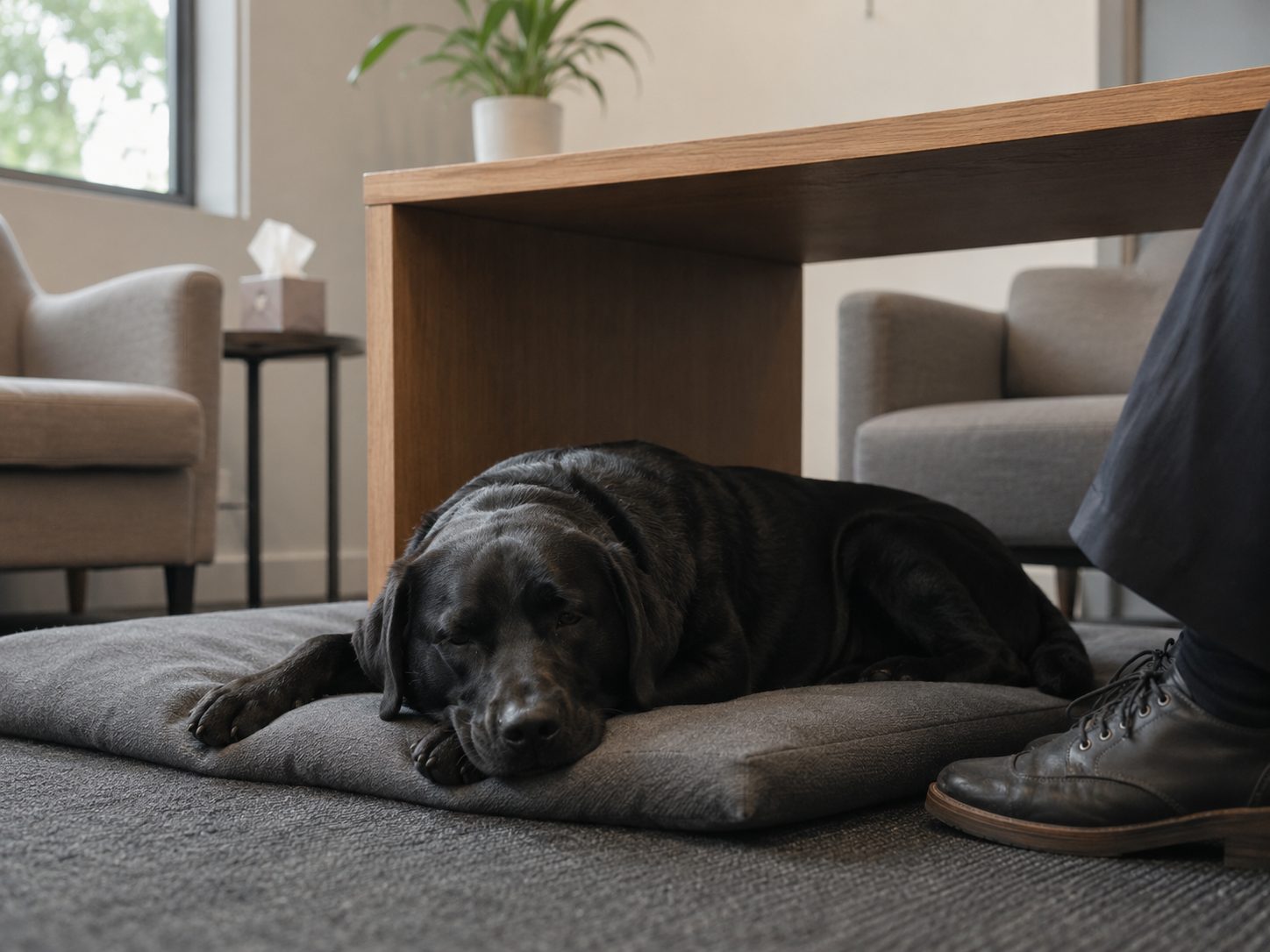
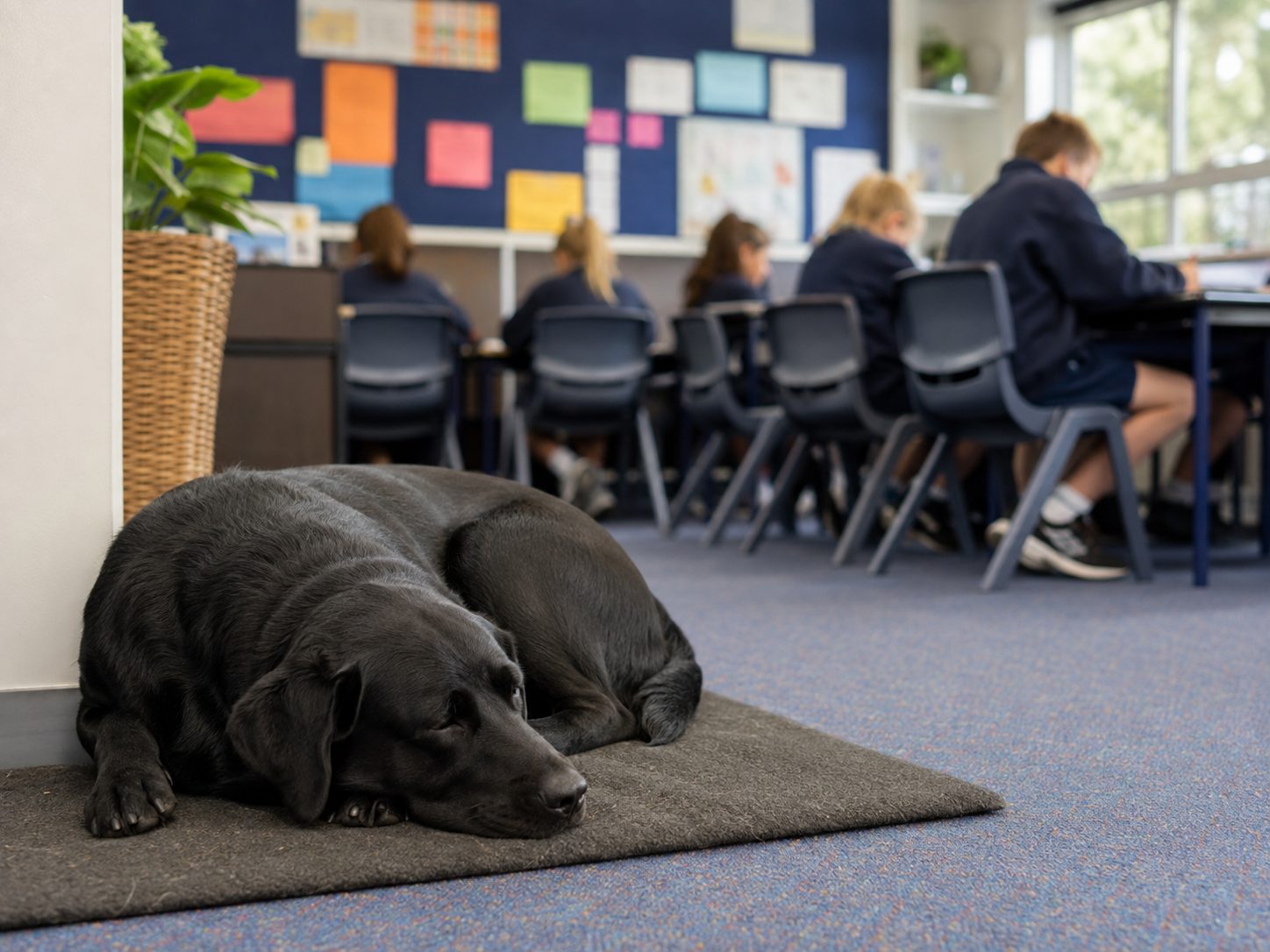
Lie under a desk for fifty minutes while a stranger cries. Walk through a corridor of two hundred children at recess without greeting one of them. Leave the sandwich that fell on the floor. Let a six year old lean on you with their whole weight. Stay down when someone shouts. Get up when your person gets up, and lie down again when they sit. Do all of that in a room where nobody has the capacity to feed you, and where the one person who could tell you what to do is busy with someone else.
That is the whole job. Most of it is doing nothing. A therapy dog is the most boring dog in the building, and that is the compliment. When I assess a dog for this work I am not looking for tricks, I am looking for a dog that can switch off in a room full of noise and switch back on when the person it lives with moves. You almost want a boring dog.
Here is the dog's side of it. Someone's crying. Not my business. Someone dropped a biscuit. Not my business. My person stood up. That's my business. A dog that thinks like that is a therapy dog. A dog that thinks where's my treat is a pet in a vest.
Why obedience does not get you there
My previous dog, Kirin, was trained for assistance work and was obedient by design. She would do anything she was told. And that was the ceiling: a dog whose good behaviour depends on a cue only works for a handler who can deliver the cue, on time, every time. Someone in pain, someone mid-episode, someone with their hands full cannot. Kirin was never placed, and the reason stuck with me. Obedience fails exactly when it is needed most.
Now put that in your workplace. You are a psychologist and your client has just started to cry. You are a teacher and a fight has broken out at the back of the room. You are an OT with both hands on a child. In every one of those moments, your dog is on its own. It has to decide. An obedient dog, when it is not given an instruction, is a very stupid dog. It waits. It looks at you. It gets up to check. A dog trained to live beside a person, on the other hand, already knows what to do, because it has been doing it at home for months.
My current dog, Murphy, is my own PTSD assistance dog. She wakes me from nightmares before I remember dreaming them. Nobody cues that. She reads the room and acts. That is the dog I build for professionals, and I build it by teaching the dog to live, not to obey.
"Obeying is not a relationship. A dog that needs to be told is a dog that needs you free to tell it, and at work you never are."
Why treats will not work either
Most schools and clinics do not allow dog treats in the room. Not food in general, dog food: the pouch of chicken, the liver treats, the kibble in your pocket. Allergies, hygiene, children who put things in their mouths, a client who is scared of dogs and does not want one scavenging around their bag. And even where nobody minds, you do not have the hands. You are mid-session. So a dog whose calm behaviour has been paid for with food walks into a room where the pay stops and is, from its point of view, unpaid. It has done the job for three weeks on $100 notes. Now you are offering nothing. Watch what happens.
Treats rent behaviour. Adolescence is when the lease runs out at home, and the day there is no hand free to pay is when it runs out at work. I use food in training when it is the right tool, and I will use it with your dog if it is. But the dog that walks into your practice has to be calm because it is calm, not because there is chicken in your pocket. Bond is control. Food is a snack.
How I do it
The PACE Program, the same program every client of mine does, because a therapy dog is just a well-raised dog with a job. Four modes, taught at home first and then moved into your workplace.
CALM is the one you will use most. Your dog learns to switch off on a tether or a mat in a busy room, with no eye contact, no talk, no touch, no treat, and to come out of it only when it is settled. We start in your kitchen and end under your desk. ANCHOR is the corridor: the dog walks beside you through noise and children and does not greet, because its brain is on you. EXPLORE is the oval at lunch or the car park at the end of the day, being a dog inside a bubble. PLAY is yours and the dog's, before work and after, and it is where the bond that makes the other three possible gets built. A dog that gets all four in a week does not need to be told anything on a Tuesday afternoon in room 12.
Then you use the modes with your client
Once the dog knows the four modes, you stop managing it and start using it. CALM is the dog lying beside a client who needs something warm and quiet in the room while they talk. ANCHOR is the dog walking nicely beside a client for company, down the corridor or around the block, no pulling, no dragging, because that client may be seventy and unsteady, or nine and easily knocked over. PLAY is the tool for the client who needs to move: a child who will not engage with you but will engage with a dog, a client who has not laughed in a month. And EXPLORE is for when you are busy with your client and the dog is free in the room, within reason, because it knows what within reason means.
You are not constantly telling the dog what it can and cannot do. You say the mode once and the dog runs it. We're in CALM. Right, I'm lying here. Oh, we're in EXPLORE. I'll have a sniff around and leave the bag alone. That is the difference between a dog you bring to work and a dog that works.
We film it. A fifty-minute settle in your actual room, on video, is worth more to a principal than any certificate, and it is worth more to you, because you can see the dog do it before you ask anyone for permission.
Temperament first, so we assess first
Not every dog can do this, and I would rather tell you at the start than take your money for four weeks. Temperament decides the ceiling. A dog that recovers quickly from a surprise, does not need to greet everyone, and can already sleep through a dinner party is most of the way there. A dog that lives on the high tide, that cannot be in a room without checking every person in it, has a long way to go, and some dogs will never be comfortable with a stranger crying a metre away. That is not a training failure. It is the dog.
So the first step is an assessment, not a program. I come to your home or your workplace, I read the dog, and I tell you where it sits and how far that is from the goal. From there we know whether this is four weeks of work, a longer road, or a different dog. The earlier we do this the easier it is: a puppy or a young dog raised on the four modes from day one grows into the job instead of being retrained for it, and the dog that has been at your feet at home for two years will be at your feet at work in weeks.
The Dog at Work pack
This is the paperwork layer, and it is what most people think they are buying when they buy a certificate. You get a signed letter of assessment describing what your dog was assessed on and what it can do. A workplace risk register, built on the Victorian Department of Education template and the Animal Therapies Ltd code of conduct, filled in for your setting. A one-page dog-at-work policy you hand to your manager or keep on file as a business owner: the dog's hours, where it rests, who handles it, what happens if a child is allergic or a client is frightened, what happens if something goes wrong. And the video.
That is the whole gate. It satisfies the Victorian schools policy, which asks for "appropriate and accredited training" and names no provider. It gives an insurer the "evidence of training" line they want. It gives you, as a business owner, a file that turns the dog from a liability question into a settled part of how the practice runs.
Step one: the assessment
$400, in your home or your workplace.
Ninety minutes. I read the dog, you get a straight answer on where it sits and how far that is from the job. If the dog can do this, the PACE Program follows: four weekly sessions with video feedback between them for $1,600, $2,000 all up, with the Dog at Work pack included for professionals. Stop after the assessment and $400 is all you pay.
With a Hachi Way associate trained and supervised by me, the four weeks are the same $1,600. Payment plans: two instalments of $810 or three of $545.
Book the assessment →Write "therapy dog" and your profession in the goals box so I know what I am assessing for.
What your employer will ask for
I have sat on both sides of this conversation. Here is the list, and what each item is actually checking.
- Evidence of training and assessment. A letter, on letterhead, saying who assessed the dog, on what, and when. This is the line the Victorian schools policy and most insurers care about. Nobody has ever asked me which certificate. They ask whether there is one.
- Vet records. Current vaccinations, worming and flea treatment, a health check within the last twelve months, and proof the dog is desexed. The industry code says desexed. Your vet does this in one visit.
- Council registration and breed. Registered with your council, not a restricted breed, never declared dangerous.
- Insurance. If you are staff, the school or practice will check its own public liability covers an animal on site, and the Victorian policy says the staff member carries pet insurance. If you own the business, ring your broker and ask them to note animal-assisted work on your professional indemnity and public liability. Insurers ask for "proper training and certification" and name no scheme. The letter is the answer.
- A risk register. Allergies, phobias, cultural and religious objections, bite risk, hygiene, and the dog's own welfare: where it rests, how long it works, where the water is, how it gets out if it needs to. Schools are told to use one and given a template. I fill it in with you.
- Consent. A way for a client, a parent or a student to say no thank you, and a plan for the session when they do. The dog goes to CALM in another room. Nobody is forced to sit with a dog.
- A written policy. One page. Hours, handling, rest space, exclusion days, incident steps. For staff, this is what the principal signs off. For owners, it is the document that means you never have to think about it again.
If you own the practice
You do not have a permission problem. You have a design problem. The dog is coming to work either way, so the only question is whether it is a complement to your business or a chore. The dogs I see fail in private practice fail from too much freedom: they wander the waiting room, they greet every client, they lie in the doorway, and after six months the owner is managing a dog between appointments instead of running a practice. The fix is the same as at home. The dog has a spot. It rests there. It works a set number of hours. It has an exit. A dog on the four modes in a clinic is a dog nobody notices, and a dog nobody notices is a dog everybody likes.
If you want to volunteer instead
Not every therapy dog belongs to a therapist. If you have a steady dog and want it to work a few hours a week in a hospital, an aged care home or a school, four organisations in Victoria run volunteer teams, and they are where those institutions actually source their dogs. Hospitals do not take a dog off the street. They take one from a program.
- Paws Pet Therapy. Hospitals, aged care and Victorian government schools, including the whole-school visitation program on the Schools Mental Health Menu. Volunteer teams, with an assessment day.
- Story Dogs. Reading dogs in primary schools. Dog over a year old, council registered, a full-day course for the handler, and a ten-point dog team assessment.
- Delta Therapy Dogs. Visiting teams to hospitals, aged care and schools nationally. Dog between eighteen months and nine years, vet check, temperament test, annual reassessment.
- Lort Smith Pet Therapy. Supplies dogs to the Royal Children's, Peter Mac, Monash and aged care. Dog over eighteen months. Intake is closed at the time of writing, with the next round expected in 2027.
Two things to know before you apply. Every one of these programs requires positive handling of the dog while it is working, which is exactly how a dog in CALM or ANCHOR is handled anyway, so the program prepares you for their assessment, not against it. And most of them will not take an assistance dog, because an assistance dog already has a job. If your dog is an assistance dog, its work is with you.
Choosing a dog for the job
Most of the dogs I assess for this work already live with the professional and were never bought for it. That is fine. If you are choosing one, start earlier than you think. The eight weeks before a puppy comes home decide more than the eight months after, and the Good Puppy Blueprint starts at five weeks, while the puppy is still with the breeder, on the same four modes the dog will run at work. If you are buying a puppy for this work, the therapy dog breeder list covers the breeds, what to ask a breeder, the seven-week test and the Australian breeders who raise for it.