No. There is no law in Australia that requires a therapy dog to hold a certificate, and there is no body that issues one with any legal weight. What you need is a dog that can do the job, and a piece of paper your workplace will accept as evidence that it can. Those are two different things, and most people buy the second one hoping it comes with the first.
I get this question two or three times a month, usually from a psychologist, a teacher or an OT who has already got the dog and has already been told by a colleague that they need to "get it certified". So here is what the law actually says, what your workplace will actually ask for, and what the dog realistically has to be able to do. Then I will tell you why the last one is the only one that is hard.
What the law says
The Disability Discrimination Act 1992 covers assistance animals. An assistance dog is trained to help one person with a disability, and the Act gives it public access rights: cafes, trains, hospitals, the lot. Queensland backs that with its own scheme, the GHAD Act, with approved trainers and a Public Access Test; Victoria has no state scheme, so the training and the test behind the dog are the proof. Either way it is a regulated job with a real test behind it. The full difference is here.
Therapy dogs are not in the Act. A therapy dog works alongside a handler to support other people, a client, a class, a ward. It has no public access rights, no legal definition, no register and no accreditation. A 2024 survey of Australian assistance and therapy dog programs, out of the University of Melbourne and the University of Adelaide, put it plainly: therapy dog programs here are mostly unregulated, there are no registration or accreditation requirements, and there are no uniform minimum standards.
There is an industry code. Animal Therapies Ltd ratified a code of conduct in January 2024, adapted from the University of Queensland's minimum standards. It says the handler and dog "should" complete specialised training and assessment, "preferably" nationally accredited. Should, preferably. It names no provider and no certificate, and it is voluntary. It is a good document and I use it. It is not a rule.
Every trainer in Melbourne who sells a therapy dog course will tell you the same thing if you read their page to the bottom. The honest ones say it out loud: therapy dog training is not legally protected, regulated or legislated. They are right.
What your workplace will actually ask for
So the gate is not the government. It is a principal, a practice manager or an insurer who has to say yes, and who wants to see something before they do. Here is what that something usually is.
In Victorian government schools the policy is called Animals: Wellbeing and Engagement, and it asks for four things when a staff member wants to bring their own dog. The dog and the handler have "undertaken appropriate and accredited training". A legal agreement is signed on the department's template. The school keeps a risk register, and there is a template for that too. The staff member carries the pet insurance. Read it closely and you will notice what it does not say: it names no course, no provider, no certificate. Schools are told to "do their own evidence-based research". Your principal is not checking a licence. They are checking that someone competent looked at your dog and wrote down what they saw.
Psychologists and allied health are looser again. AHPRA has no animal-assisted therapy standard. The advice from the profession is to keep the dog inside your existing scope and hold professional indemnity that lists animal-assisted work. Insurers ask for "proper training and certification" and, once more, name no scheme. A letter of assessment on letterhead, a risk register and your vet's records is what they actually want in the file.
The one place a certificate genuinely will not help you is the volunteer programs. Delta, Lort Smith, the hospital and aged care visiting schemes, and Guide Dogs Victoria's school dog program assess dogs themselves and accept nobody's paperwork. If that is the route you want, go straight to them.
What the dog realistically has to be able to do
This is the part that is hard, and it has nothing to do with paper.
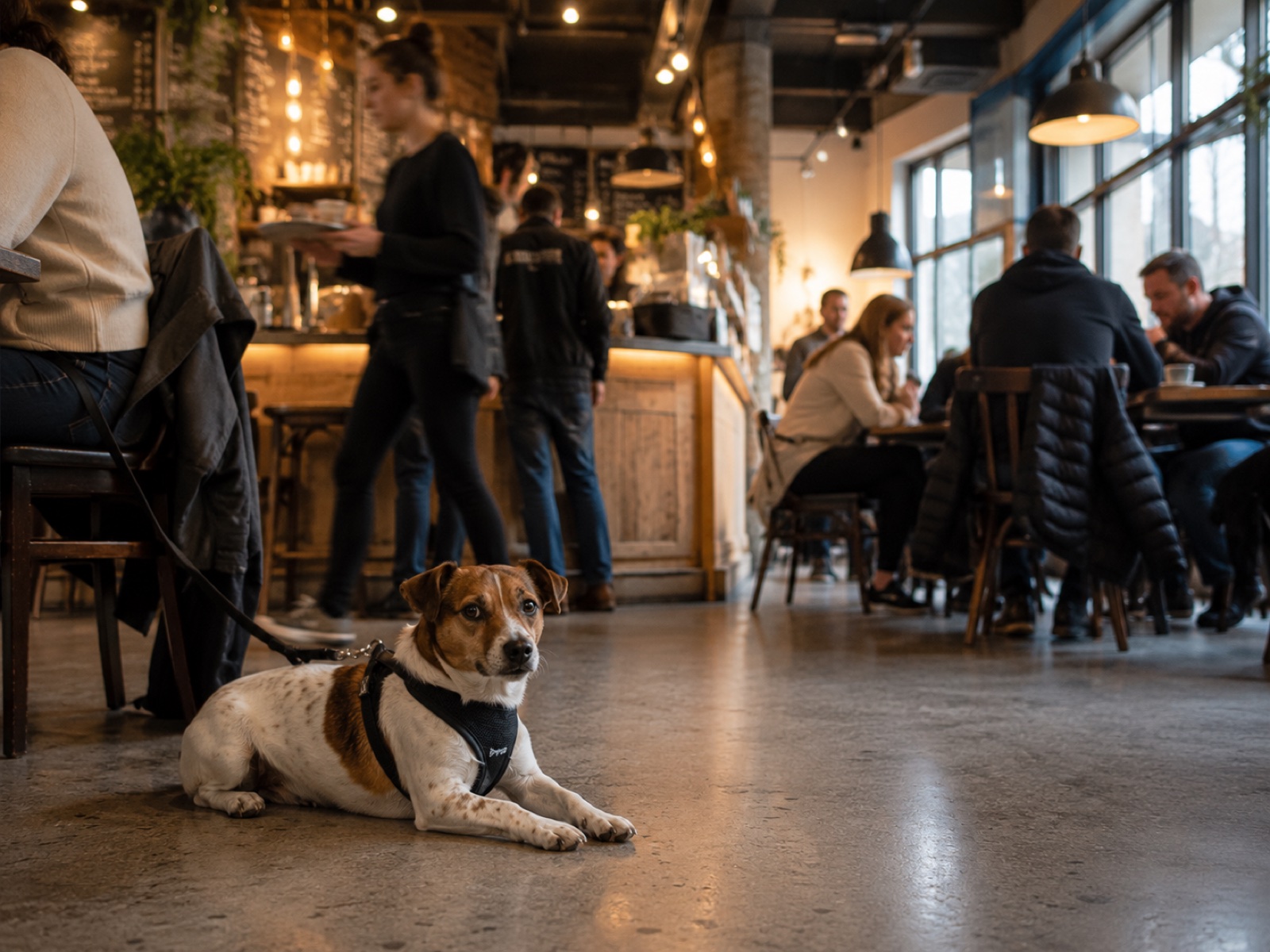
Lie under a desk for fifty minutes while a stranger cries. Walk through a corridor of two hundred kids without greeting one. Leave the biscuit that fell on the floor. Let a six year old lean on you with their whole weight. Stay down when a client raises their voice. Get up when your person gets up, lie down again when they sit. Do it in a room where nobody has the capacity to feed you, and where the one person who could tell you what to do has their hands full with someone else.
That is the job. A therapy dog is the most boring dog in the building, and I mean that as the highest compliment I give. Here is the dog's side of it. Someone's crying. Not my business. Someone dropped food. Not my business. My person stood up. That's my business.
Why obedience will not get you there
My previous dog, Kirin, was trained for assistance work. Obedient by design, would do anything she was asked. She was never placed, and the reason changed how I train. A dog whose good behaviour depends on a cue only works for a handler who can deliver the cue, on time, every time. Someone in pain, mid-episode, hands full, cannot. Obedience fails exactly when it is needed.
Now picture your workplace. Your client has just started crying. A fight has broken out at the back of the room. You have both hands on a child. In every one of those moments your dog is on its own and has to decide. An obedient dog, when it is not given an instruction, is a very stupid dog. It waits. It looks at you. It gets up to check what you want. A dog that has been taught to live beside a person already knows, because it has been doing it at home for months, in the kitchen, at the cafe, on the couch it is not allowed on.
My current dog, Murphy, is my own PTSD assistance dog. She wakes me from nightmares before I remember dreaming them. Nobody cues that. She reads the room and acts. That is the dog you want in your practice, and you do not get it from a command list.
Why treats will not either
Most schools and clinics do not allow dog treats in the room. Not food, dog food: the chicken pouch, the liver treats, the kibble in your pocket. Allergies, hygiene, children who put things in their mouths, a client who is scared of dogs and does not want one sniffing around their bag. And even where nobody minds, you are mid-session and do not have the hands. So the dog whose calm has been paid for with chicken walks into a room where the pay stops and is, from its point of view, unpaid. It has done the job for three weeks on $100 notes and now you are offering nothing. You will find out fast what it was actually working for.
Treats rent behaviour. At home the lease runs out at adolescence. At work it runs out the day there is no hand free to pay. I use food in training when it is the right tool for the dog in front of me. But the dog that walks into your practice has to be calm because it is calm. Bond is control. Food is a snack.
"You almost want a boring dog. A dog nobody in the room notices is a dog everybody in the room likes."
What I do instead
The same thing I do with every dog: the PACE Program. Four modes, taught at home and then walked into your workplace. CALM under your desk, built from a tether in your kitchen. ANCHOR through the corridor with the dog's brain on you. EXPLORE on the oval at lunch. PLAY before and after work, which is yours and the dog's and where the bond that makes the other three possible gets built. A dog that gets all four in a week does not need to be told anything on a Tuesday afternoon in room 12.
Then the paperwork, because your workplace still wants it. A letter of assessment describing what your dog was assessed on and what it can do. A risk register on the Victorian schools template, filled in for your setting. A one-page policy for your manager or your own file. And a fifty-minute settle in your actual room, on video, which is worth more to a principal than any certificate ever printed. I call it the Dog at Work pack and it comes with the program. The full picture, pricing and the questions people ask are on the therapy dogs page.
And if you have not got the dog yet, start earlier than you think. The eight weeks before a puppy comes home decide more than the eight months after, and the Good Puppy Blueprint starts at five weeks, while the puppy is still with the breeder.