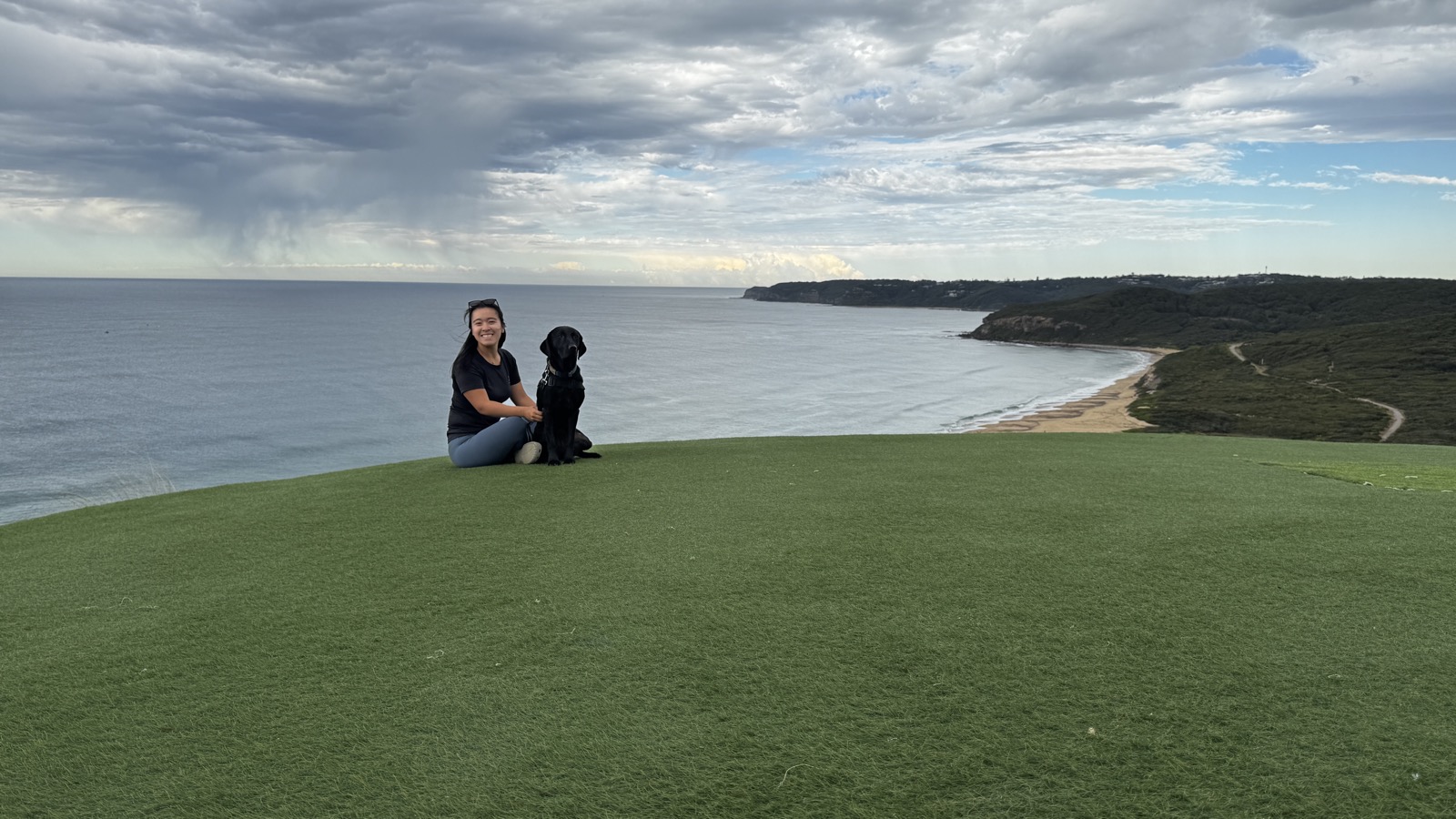
I never taught Murphy to sit, because a dog that sits when it's told is a dog that needs to be told, and I wanted a dog that reads the situation and makes the decision herself. She sits all the time. I just had nothing to do with it.
I started saying the word sit when she was about a year and a half old, and only so she'd have a label for something she was already doing. We walk, she is on my left on a loose lead, I stop to talk to someone, and she goes, fine, this is going to take a while, and sits, because that is how you conserve energy when your person has stopped. If the conversation goes long she lies down. If a dog walks past she watches it, decides it's none of her business, and looks back at me. Nobody said anything. She read the room.
Obedience needs my eyes on my dog
Here is the difference in one kerb. Most people cross a road like this: sit, wait, look for cars, okay, go. It works, and it needs the handler to be fully present at every single crossing for the life of the dog. My dog does not know the difference between the pavement and the road. All she knows is when I walk she walks, when I stop she stops. That rule needs nothing from me. It works when I'm on the phone, when I'm carrying shopping, when I've got a client's dog in the other hand. It is the same rule at the kerb, the shop door and the car park, so there is nothing to remember.
An obedient dog is only as good as the person giving the cues, and the person is mostly distracted. That is not a criticism. That is life. Walking with a friend, mid-conversation, brain somewhere else: that is where most of a dog's week happens, and it is exactly where obedience has nothing to say.
Where it came from
I did not arrive at this on a walk. I arrived at it through people who could not give a command.
My mum sent me to a dog training course at eighteen after I told her I wasn't going to university, which, being Asian, was not really acceptable. The course was the bait and vet school was the plan. I did the degree, came out still not wanting to be a vet, and went back to dogs the long way: a classroom first, then assistance dogs.
Assistance dogs are trained for people with PTSD, autism, epilepsy. Some of those people cannot always speak. Some are mid-episode at the moment the dog is needed most. A dog that waits for the word is useless to them at exactly that moment. My previous dog, Kirin, was trained for that work and was beautifully obedient, and that turned out to be the ceiling: her good behaviour depended on a handler who could deliver the cue and the reward on time, every time, and the people who need an assistance dog are the people who often can't. Kirin was never placed. The lesson stuck. Obedience fails when it is needed most.
So the question changed. Not how do I get a dog to do what I say, but what does a dog look like that doesn't need to be told? Murphy is my answer. She is now my own PTSD assistance dog, and she wakes me from nightmares before I know I'm having them. Nobody cued that. There was nobody awake to cue it.
Piano
I learned piano as a kid the way most Hong Kong kids do: sheet on the stand, play what's written, don't improvise. I can still play anything you put in front of me. Take the sheet away and I have nothing. That is an obedient dog. Fluent as long as the instructions keep coming, lost the moment they stop. What I wanted was a dog that could improvise, which means a dog that has been allowed to think.
Most of the time we take that opportunity away from them. We tell the dog what to do or what not to do, and never leave the gap where it could have worked it out. Then we call it a dog that doesn't listen.
This is not a soft dog
When I say I don't want a dog that obeys, people hear that my dog does whatever she wants. She doesn't. I'm quite firm with my boundaries, and there is never a mix-up: same rule today, same rule tomorrow, same rule from my husband. If she jumped on you I'd ask you to turn away, because I'm over here and I can't fix it from there. She has never once moved me by pulling, so she has never learned to try. The structure is all there. What's missing is the running commentary.
There are no bad dogs, only confused dogs. The confusion is almost always ours: we say one thing, do another, and change it again on Tuesday. Take the confusion out, hold the boundaries, and a dog will choose the right thing far more often than people expect, because choosing well is cheaper for her than getting told.
The talk
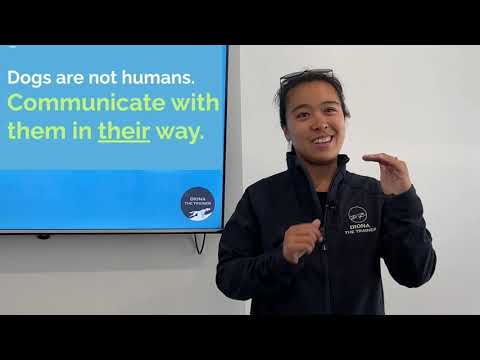
I said most of this out loud for the first time in November 2022, my first year in business, at a seminar PetWell put on in Docklands. Murphy slept on her mat through all 27 minutes, which did more for the argument than the slides. It is still on their channel, and the whole twenty-seven minutes is here on this site with the parts marked out so you can jump to the bit you want. I stand by nearly all of it. The one thing I would change is the loose-lead advice at the end, which has since grown into a whole system of its own.
Everything I teach now grew out of that room: the four modes, the waterline, the reading. But the root is the sentence I opened with. I never taught my dog to sit. I taught her that thinking pays.
If you want the dog that doesn't need to be told, it starts with a consultation, and most of the first session is me teaching you to stop talking.
Common questions
Does Murphy know any commands at all?
A few, and she learned them late, as labels for things she was already doing. Sit, let's go, ready, finish. What she does not have is a life run on cues. The cue is the exception, and the decisions are hers.
Isn't a sit at the kerb safer?
It is safer on the day you remember to ask for it. When I walk she walks, when I stop she stops is safer on every other day, because it needs nothing from me and it is the same rule everywhere. A rule that only works when the handler is paying attention is not a safety rule.
Is this the same as no rules, or force-free?
No. The boundaries are firm and they never change, which is the whole point. What I take out is the commentary, not the structure. And I am not in either camp of the method argument; I use whatever gets the dog clarity fastest.
Can an adult dog learn this, or only a puppy?
Adult dogs learn it, often faster than their owners do. Teenagers and older dogs who have only ever been told what to do are usually relieved to be allowed to think. The hard part is the human stopping themselves from giving the command.