An assistance dog is trained to do specific tasks for one person with a disability, and the law follows it through the door: under the Disability Discrimination Act 1992 it can go into the cafe, the train, the hospital and the office with its person. A therapy dog works beside a handler to support other people, a class, a client, a ward, and the law does not follow it anywhere. It goes where it has been invited. Everything else, the training, the testing, who you call and what it costs, comes off that one line.
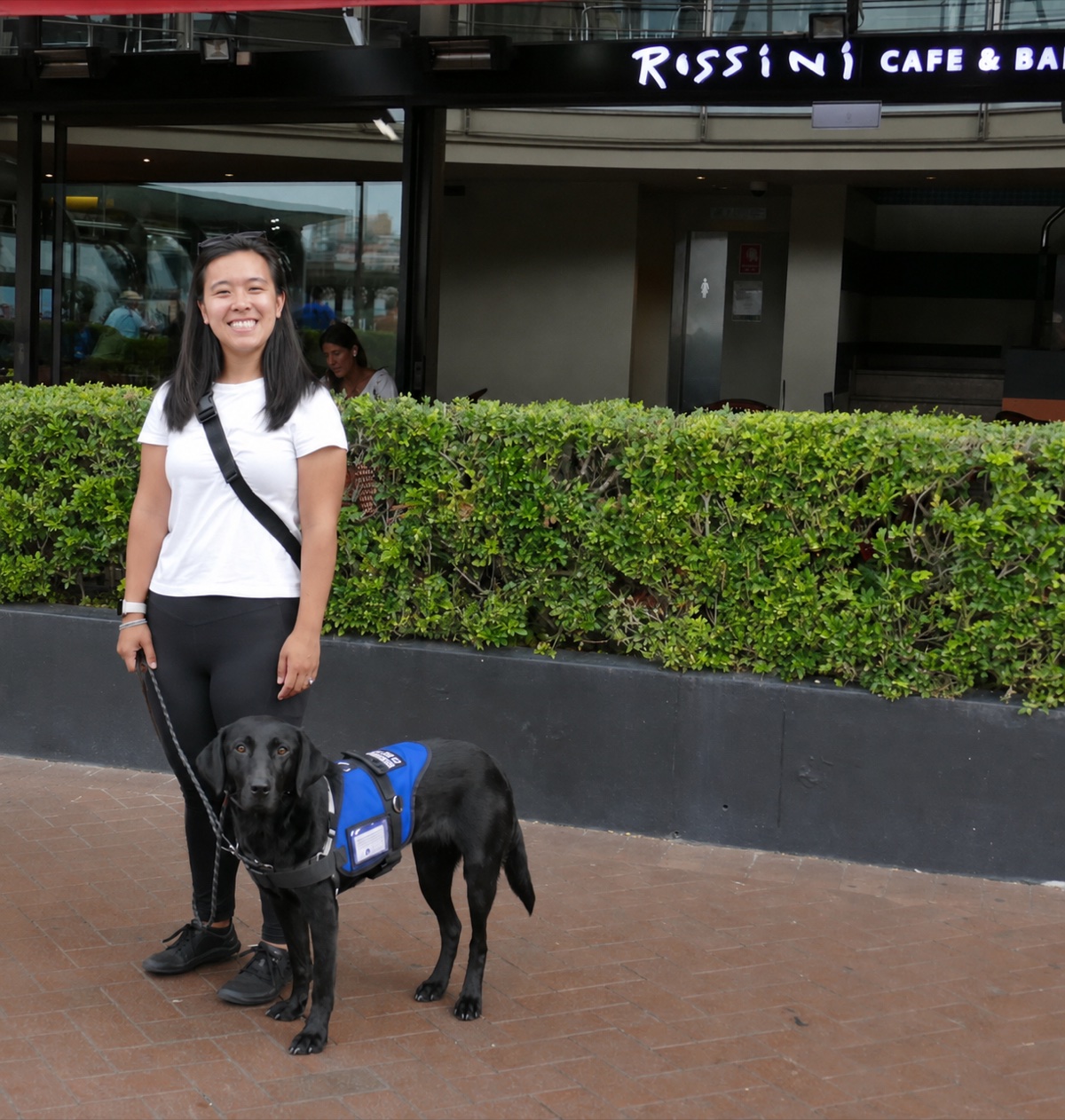
I have worked on both sides. My previous dog Kirin was trained for assistance work and never placed. My current dog Murphy is my own PTSD assistance dog. And most of the dogs I assess for work now are therapy dogs for psychologists, teachers and OTs. People ring me with the two mixed up every week, so this page is the sorting hat.
The three dogs people mean
| Assistance dog | Therapy dog | Emotional support dog | |
|---|---|---|---|
| Works for | One person with a disability | Other people, through a handler | Its own owner |
| Trained to | Do tasks that reduce the effect of the disability, and pass a public access standard | Be settled and safe around strangers in one setting for a set number of hours | Nothing specific. Be a good dog at home |
| Legal status | Disability Discrimination Act 1992 (federal). State laws add to it: Queensland has its own Act and test, Victoria has none | None. No definition, register or accreditation in Australia | None. Not an assistance animal unless task trained to the Act's standard |
| Public access | Yes: shops, cafes, transport, hospitals, work | No. Only the buildings that said yes | No |
| Who tests it | An assistance dog organisation or a trainer who assesses to a Public Access Test | Whoever the school, clinic or volunteer program trusts. Delta and Lort Smith run their own tests | Nobody |
| Time to job | 18 months to two years from puppy | Weeks, if the temperament is there. The dog is usually already living with the professional | Day one |
| Where I fit | I raise and assess the dog underneath, then refer you to a public access trainer | This is my lane: the Dog at Work program | The PACE Program. Same dog, no paperwork |
Which one do you actually need?
Ask one question. Who is the dog for?
If the answer is me, and you have a disability the dog can do something about, you want an assistance dog. Waking you from a nightmare, blocking a crowd, finding the exit, fetching the medication, interrupting the spiral. That is task work, and it comes with the right to take the dog everywhere, because the point is that you can leave the house. It is also the long road. Most dogs that fail it fail on temperament, not on training, and the test at the end is real.
If the answer is my clients, my students, my patients, you want a therapy dog. The dog is not doing tasks. It is being the right kind of presence in a room while you work, and the standard is simpler and stranger at the same time: it has to be the most boring dog in the building for fifty minutes at a stretch, without you free to tell it anything. No law is involved. A principal or a practice manager is, and they want evidence, not a licence.
If the answer is me, but I do not need it to come to the shops, you want a good dog. You do not need a vest and you do not need a certificate. You need a dog that is content, and the program that builds one. A dog that lies at your feet while you work from home is doing a job. It just is not a legal one.
Here is the dog's side of all three. My person's heart rate just went up. That's my business, I'm going to lean on her. That is an assistance dog. The kid in the corner is crying. Not my business, but I'll stay here where he can see me. That is a therapy dog. She's on the couch. I'm on the couch. That is a pet, and a good one.
Why the vest fools everyone
You can buy an assistance dog vest online for forty dollars, and you can buy a "therapy dog certificate" from half a dozen websites for not much more. Neither one does anything. A vest is clothing. A certificate from a trainer is a letter that says a trainer assessed the dog, which is useful exactly as far as the person reading it trusts that trainer, and no further. The Disability Discrimination Act does not mention vests. What it asks for is a dog trained to help with a disability and to meet the standards of hygiene and behaviour you would expect of an animal in a public place. A dog that lunges at the cafe counter in a vest is not an assistance dog. A dog that lies quietly under the table with no vest at all might be.
Queensland wrote the clearest version of this down: its Guide, Hearing and Assistance Dogs Act 2009 has approved trainers, a Public Access Test and a handler identity card. Victoria never did. Here, an assistance dog is recognised under the federal Act and the state's equal opportunity law, and the proof is the training and the test behind the dog, not a card from the government. Which is why the trainer who assesses your dog matters more here than anywhere.
Why I do not train assistance dogs
I could, and I did, for years. I stopped because of Kirin. She was obedient by design, would do anything she was told, and that turned out to be the ceiling. A dog whose good behaviour depends on a cue only works for a handler who can give the cue, and the person who needs an assistance dog is, by definition, sometimes the person who cannot. Someone in pain, someone mid-episode, someone asleep. Obedience fails exactly when it is needed. It took me a long time to work out that the dog underneath the tasks matters more than the tasks, and that is the part I now do.
So here is the honest split. I raise and assess the dog: the temperament, the recovery from surprise, the four modes, the dog that can switch off in a shopping centre and switch on the second its person moves. That is the same dog whether it ends up working for one person or for a classroom, and it is where most assistance dog candidates actually fail. Then, for the task training, the public access standard and the test, I send you to people who do that every day, and who I would send my own dog to.
Assistance dog trainers I trust in Victoria
These are my people, all in Victoria and all on the Queensland Government's approved list. Tell them you got the referral from this page and they will take care of you. I do not take a cent from any of them, and I only list trainers I would put my own dog in front of.
Paws for Assistance · North and western suburbs of Melbourne
- Training in and around the north and western suburbs of Melbourne
- Assessment consultation required to begin any dog and handler
- One-on-one training sessions twice a month at various locations
- Monthly training fees apply
- Annual fee after the Public Access Test to maintain government-approved public access accreditation
Approved under the Guide, Hearing and Assistance Dogs Act. This is who I send adults in Melbourne to. Go to the website for more information, or apply there if you are ready to start.
pawsforassistance.com.au →Playful Paws, Megs Hopman and Emily Gasko · Bairnsdale, East Gippsland
Approved under the Guide, Hearing and Assistance Dogs Act. Owner-trained program for psychosocial assistance dogs (anxiety, depression, PTSD and similar), any size or breed, positive methods, NDIS eligible. Dogs started with another trainer are welcome, and they decide how much more work the dog needs. Clients travel to them in Bairnsdale; home visits in Bairnsdale and surrounds carry a travel fee. Megs comes from the disability field as well as dog training, which is the right combination for this work. The people I refer to in Gippsland.
$275 application (assessment and training plan), $550 first yearly assessment with jacket and badges, then hourly. 6 Macleod Street, Bairnsdale. 0421 641 138, [email protected].
playfulpaws.com.au →The full list of approved trainers by state is published by the Queensland Government at qld.gov.au. I have not listed everyone on it, only the people I know.
Training your own assistance dog
Owner-trained assistance dogs are recognised in Australia if the dog reaches the standard, and I see more of them every year, because a fully trained dog from an organisation is a two to four year wait and tens of thousands of dollars, and the programs that place them are closing their lists. It is a real path. It is also the path with the most heartbreak in it, because people fall in love with a puppy first and find out at fourteen months that it will never be comfortable in a food court.
The order that works: choose the breeder before the breed, because the first eight weeks decide more than the next eight months. Raise the puppy on the four modes from the day it comes home, so CALM in a busy room is a habit before it is a task. Get a public access trainer to look at the dog early, at four or five months, when they can still tell you the truth cheaply. Then task training on top of a dog that is already content. The Good Puppy Blueprint starts at five weeks, while the puppy is still with the breeder, on exactly those modes, and it is where I would start if you are starting from scratch.
Not sure which dog you have?
Start with an assessment. $400, at your home or your workplace.
Ninety minutes. I read the dog and tell you straight where it sits: therapy work, assistance candidate, or a very good pet. If it is therapy work, the PACE Program and the Dog at Work pack follow. If it is assistance work, you leave with a plan and the names of the people to call next.
Book the assessment →Write "assistance" or "therapy" and what the dog is for in the goals box.
ReadDog at Work: therapy dog training for professionals who want their own dog beside them