Prepare your dog for a long-haul flight by making the airline crate its bedroom six to eight weeks out, moving it to the new toilet arrangement before you leave, and rehearsing the place it's landing in while you still have a garden to fall back on. The flight is the part your dog sleeps through, if the crate already means sleep. The first week landed is where it goes wrong, and nobody prepares for that because nobody sells it.
I've just spent four days doing exactly this with a past client's dog, a Cavoodle moving to New York. Here's what the work actually looks like, and what I'd tell any owner with a flight date and a vague feeling the dog isn't ready. You're right. It isn't. Not because of the plane.
The paperwork, briefly
This post is about the dog, not the forms, but the forms come first on the calendar so here's the shape of it. Qantas doesn't carry pets in the cabin, so everything leaves Australia as freight through a pet transport agent (Jetpets, Dogtainers, PetRelocation and others), and the agent runs the export permit, the vet checks and the crate spec. Smartraveller has the government overview. The destination sets its own import rules: for the US, that's the CDC Dog Import Form, an ISO microchip and a dog at least six months old, with Australia counted as low risk for rabies. And if the move isn't permanent, check now that the country you're going to is one your dog can come back from, because a return from an unapproved country means 180 days somewhere approved first, then a minimum of ten days at Mickleham. Your agent is the source for all of it. The rules change; the dog rules below don't.
The flight is the smallest part
A relocation is a dog changing every rule of its life in the same week. The box it sleeps in, the surface it toilets on, the way it gets around, the size of its home, the people holding the lead. Owners prepare for the flight, which is fourteen hours, and not for the destination, which is the rest of the dog's life and the only part you can actually rehearse.
Here's the version I see when a dog lands unprepared. Day one it won't toilet, because there's no grass and it has only ever weed on a lawn. Day two it goes on the rug at 3am. Day three it screams in the lift, because a lift is a small metal room that moves and it has never been in one. By the end of the week the owner is carrying a 15 kilo dog through the lobby and messaging me from a different time zone. What went wrong is that the dog was trained for the flight and moved to a life it had never seen.
The crate comes first, always
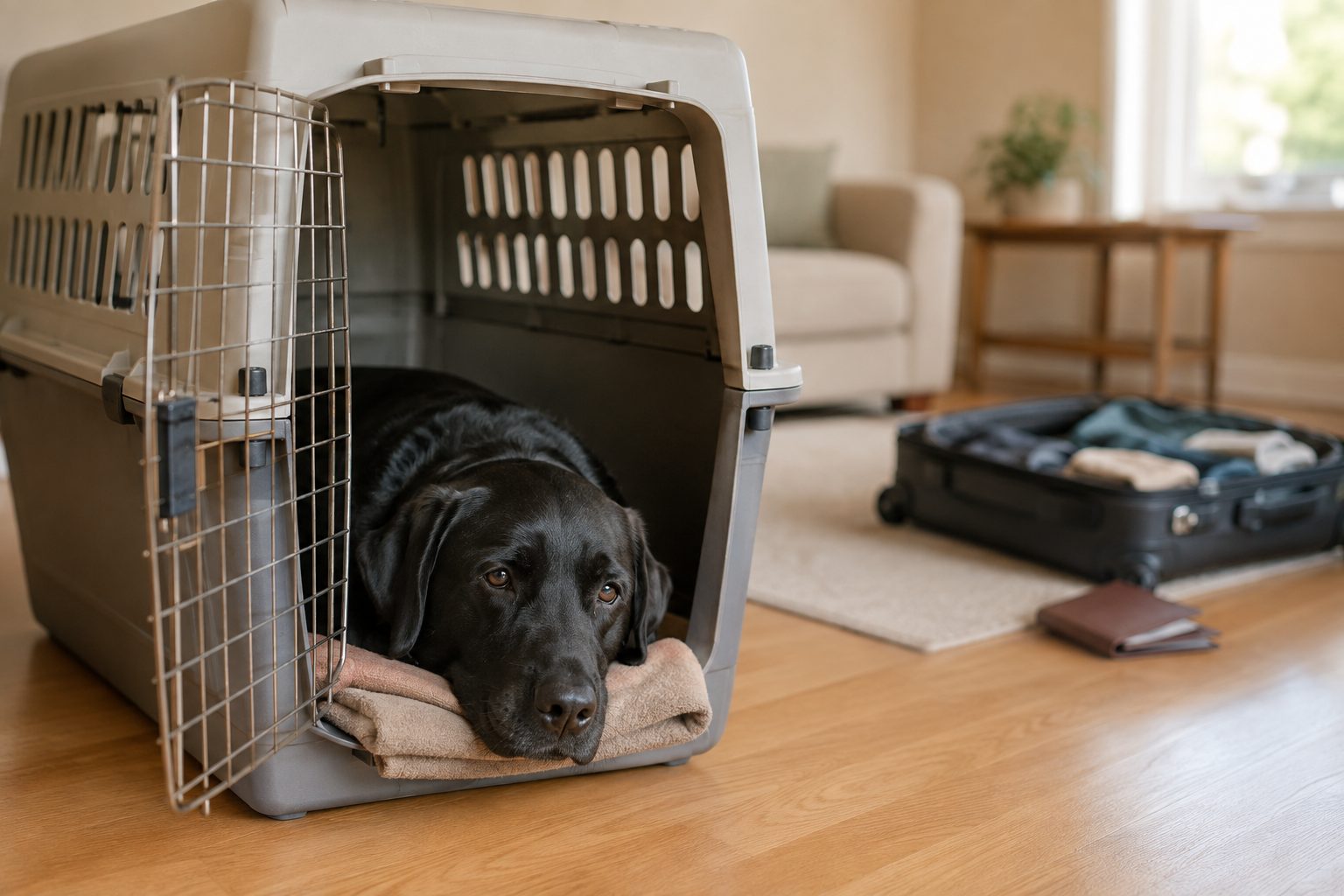
Airlines refuse a sedated dog, so the only thing between your dog and fourteen hours of panic in a dim, loud hold is whether the crate already means rest. Not tolerates. Sleeps in it. Chooses it when the house gets busy.
Buy the actual airline crate early and put it in the busiest room in the house, not the laundry. The skill is switching off inside the noise, and you can't build that in a quiet room. Don't cover it: the hold isn't a den, the airport isn't a den, and you can't cover your dog in a cafe. Meals go in the crate. The chew, a goat horn or an antler, lives in the crate and only the crate. It doesn't fly: airlines don't allow chews or toys in the crate, and the bedding that does fly is a thin blanket or an old T-shirt, not the fluffy bed. The door closes the night you find the dog lying flat inside on its own, and then you do nothing about the noise. Every door that opens for whinging teaches the dog that the door opens for whinging, and you'll regret it in a freight shed.
"Nobody cries at the crate. Put the dog in, walk away, cry in the car."
Then the crate moves, because the dog is going to be carried, trolleyed, driven and forklifted by strangers. Dog inside, door shut, into the car, round the block, into the garage with the light off. Twice a week. Then the airport noise on your phone during crate rest, quiet first, then loud. You want a yawn. A yawn isn't tiredness, it's a dog right at the edge of what it can handle and handling it.
Where is your dog landing?
Before you train anything else, write down what a Tuesday looks like for your dog in the new place. Precisely. Where does it wee, on what, who takes it? How does it get anywhere, on foot, in a car, on a train, in a bag? House with a yard or flat with a lift? Snow, heat, salt on the paths? Off-lead culture or on-lead by law? How many hours alone? Then write the same list for now. The differences are the plan, and they're never the ones people expect. The dog moving to a house in Texas doesn't have it easy; it will never walk anywhere again and spends nine hours a day alone. The dog moving to London isn't worried about the flat; it's about to meet a hundred off-lead dogs in the park.
Whatever the new life is, it starts here, weeks out. A city dog learns a toilet cue and moves from grass to concrete, a turf square on the driveway, halved, then gone, and stops signing every post so it learns to empty in one wee. It rides trams as a rehearsal for the subway, and if it's small, practises the bag, because in New York a dog rides the subway in a carrier. A driving-suburb dog learns the car as a second bedroom and builds up the hours alone. A dog moving somewhere with a dog on every corner learns, above everything, that other dogs are none of its business.
The timeline
| When | What |
|---|---|
| Eight weeks out | Airline crate bought, built, in the busiest room, uncovered. Every meal in it. Write down what a Tuesday looks like for the dog in the new place and circle every difference from now. |
| Six weeks out | Door closed for sleeps, the night you find the dog flat inside on its own. New toilet arrangement starts. First rehearsals of the new way of getting around: the busy strip, the long drive, or the off-lead park walked past on a lead. |
| Four weeks out | Crate every night. Crate rides in the car with the dog inside, twice a week. Turf square halved, then gone. Lifts, trams, a shopping centre. Soft carrier ten minutes a day if there's a cabin leg. |
| Two weeks out | Concrete only, garden closed. Airport noise during crate rest. Crate carried by someone the dog doesn't live with. Three rules on the fridge for whoever has the dog. |
| Final week | Nothing new. No farewell outing. One quiet day. Last meal four hours before handover, last wee at handover. |
| First week landed | Toilet trip within an hour, crate in the busiest room, a day of nothing. Three lead toilet trips a day, short walks on the block, no park, no visitors, no greetings. |
The people holding the lead
In the last weeks the dog is usually not with the person reading this. You've flown ahead. The dog is with your parents or your brother, and one of them is a plan-follower and the rest aren't. So the plan is three rules on the fridge, not a document: the dog sleeps in the crate every night, door shut, uncovered; every wee is on the lead, on the new surface, on the word; walks are outings, no greetings, no park. If those three aren't happening, nothing else matters.
Want the short version on the fridge? The free two-page checklist is the timeline and the three rules, and you can hand it to whoever is minding the dog.
Coming the other way? A dog arriving in Australia comes out of ten days at Mickleham into a house it has never seen. The first week after quarantine is the mirror of everything above.
The dog that can't walk a busy street without the lead going tight, or can't pass a dog in a corridor, is a different conversation. That dog needs hands on a lead before it needs a plan, and I don't teach that in writing. Book a consultation and we'll sort it before the flight, not after.