
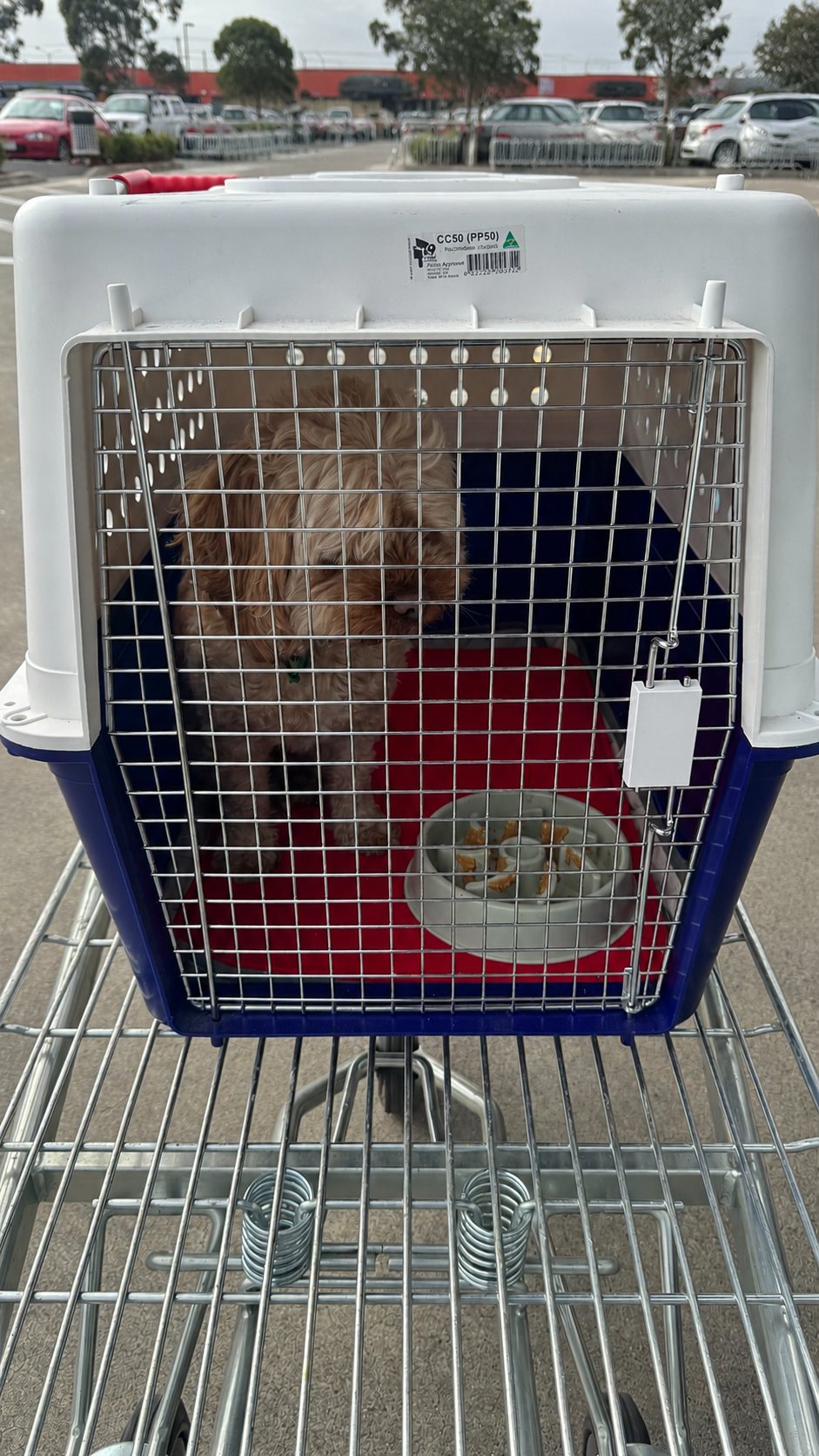
Start crate training six to eight weeks before the flight, in the actual airline crate, in the busiest room in the house, with the door open and every meal inside it. Four weeks is workable. Two weeks is a box. And the timeline most people follow is backwards: they spend the whole period getting the dog used to being inside the crate, and none of it getting the dog used to the crate moving, which is the only thing that happens on flight day.
I prepare dogs for relocation, and the crate is the part I start first and the part owners start last. Here's the order, and why the last fortnight matters more than the first.
Why the crate has to be a bedroom, not a box
Airlines don't sedate dogs, and the Australian Veterinary Association's position is that they shouldn't be. So the only thing between your dog and fourteen hours of panic in a dim, loud hold is whether the crate already means sleep. Not tolerates. Sleeps in it. Walks into it when the house gets busy because that's where the quiet is. That's a habit, and habits take weeks, which is why the crate is the one thing in a relocation you can't leave late.
The order that works
Weeks eight to six. Buy the actual airline crate, the one the dog will fly in, not a training crate you'll swap later. Your transport agent gives you the size: the dog stands with its ears clear of the roof, turns fully, lies flat. Build it and put it in the busiest room in the house. Not the laundry, not the spare room. The kitchen, the living room, wherever the family actually is. The skill you're building is switching off inside the noise, and you can't build that in a quiet room. Every meal goes in the crate, door open. The chew, a goat horn or an antler, lives in the crate and only the crate.
Don't cover it. Every guide on the internet says drape a blanket over it to make a den. I don't. The hold isn't a den, the freight shed isn't a den, and you can't cover your dog in a cafe. A dog that can only settle with the world blocked out has learned to settle in the dark, not to settle. Open to the room from day one.
What goes in it. An absorbent liner and a thin blanket or an old T-shirt of yours, the same one from now until landing. Not the fluffy bed. Airlines don't allow bulky bedding, toys or chews in the crate, so don't teach the dog to sleep on something it can't take with it. The chew is a training tool for the first fortnight, and it stays home.
Week six. The door closes the night you find the dog lying flat inside on its own. Not the night you decide it's time. Close it quietly, walk away, and then do nothing about the noise. No talking, no "it's ok", no tapping the crate, no letting it out to try again tomorrow. A dog protesting in the crate is working out that demanding gets nothing, and that's the lesson. Every door that opens for whinging teaches the dog the door opens for whinging. Twenty minutes of noise on night one is normal. Past that, message your trainer. Don't open the door.
"The dog sleeps in the crate every night from here. That's not a training session, that's where it lives now."
Weeks four to two: the crate moves. This is the part everyone skips. On flight day your dog gets picked up in that crate, carried, put on a trolley, driven, set down by strangers in a shed full of other dogs, forklifted, and loaded. So from four weeks out, the crate travels. Dog inside, door shut, lift the crate, carry it to the car, drive round the block, set it down in the garage, open the door only when the dog is settled. Twice a week. Then once at night with the garage light off, because the hold is dim. Then have someone the dog doesn't live with do the carrying. The dog is learning the one thing that matters on the day: the box moves and nothing bad happens.
The last two weeks: the airport. Once the dog sleeps in the crate and rides in it, play the airport. Jet engines, forklift reversing beeps, roller doors, dogs barking, on your phone next to the crate during a rest. Quiet the first time, real volume over a fortnight. You want a yawn. A yawn isn't tiredness. A yawn is a dog sitting right at the edge of what it can handle and handling it, which is exactly where learning happens. A dog that goes rigid and stares at the door isn't resting, it's waiting. Turn it down, stay in the room doing nothing, try again tomorrow.
What if there's less than six weeks?
Compress it, don't reorder it. The crate still goes in the busiest room today, the meals still go in tonight, the door still closes the first night the dog is flat inside. What you lose with a short timeline is the moving and the noise, so if you have to cut something, cut the last step, not the first. And if the flight is next week, the honest answer is that the crate will be a box, and the dog will get through it the way dogs get through things. Put the family's energy into the first week landed instead, because that's where the real damage happens.
The second crate nobody plans for
If your dog is small and one leg of the trip is a domestic flight in the new country, it may ride in the cabin under the seat in a soft carrier. That's a different box and a different skill: zipped in, on the floor, quiet for hours with strangers' feet next to it. Find out now which legs are hold and which are cabin, and if there's a cabin leg, the soft carrier gets ten minutes a day on the floor while you watch TV, starting the same week as the crate.
The crate is chapter 2 of Flight-Ready, and the reason the guide exists is that the crate is the one thing every owner knows about and almost nobody does in the right order.