No. Staffies are not an aggressive breed. What they are is strong, mouthy and built for drive, and a staffy with nowhere to put that drive gets called aggressive by the time it turns three. The lunging at the end of the lead, the barking at the dog across the road, the mouth on your forearm: in the staffies I see in Melbourne, nearly all of it is arousal with no outlet, not a dog that wants to hurt anything.
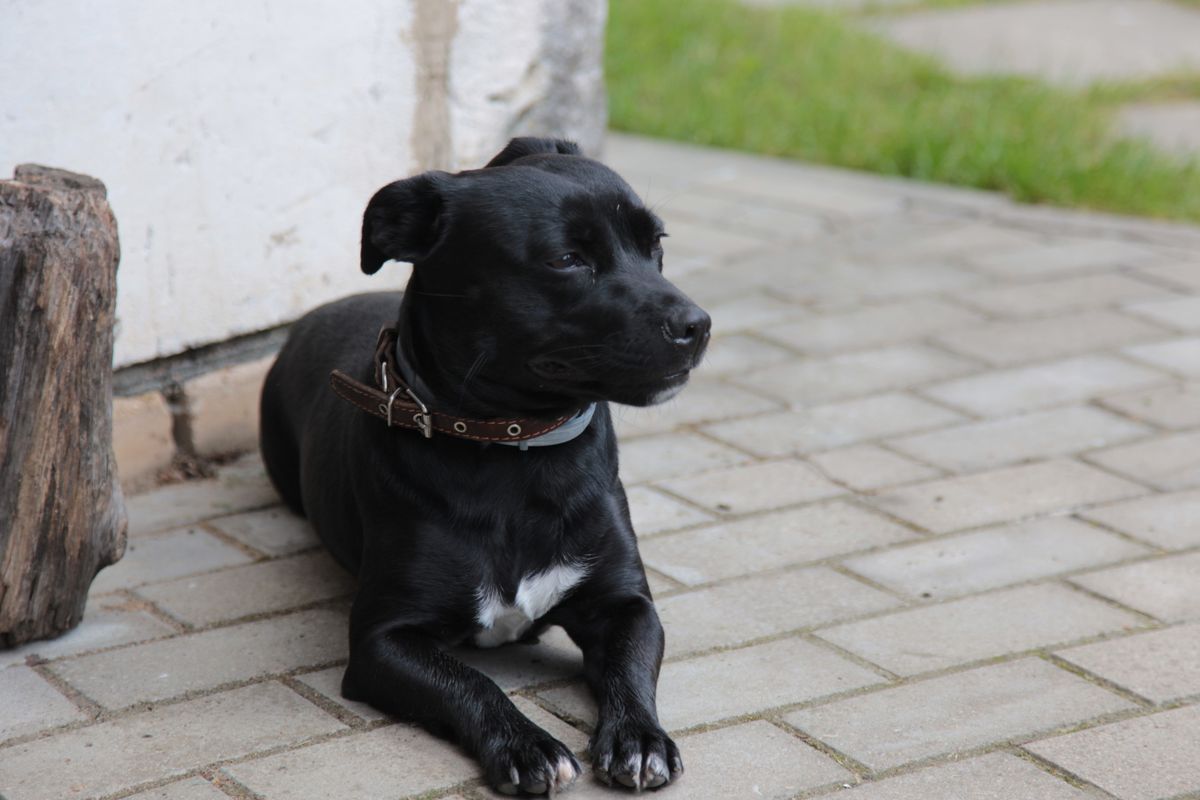
English Staffy, Staffordshire Bull Terrier, American Staffy, Amstaff, blue staffy, and the fifty crosses the shelter writes down as "staffy x". Different sizes, same shape of problem. A tight, muscular body, a big jaw, and more drive than the average Melbourne backyard knows what to do with.
What a staffy was built for
Grip and hold. That is the job the breed was made for, and it is still in there. A Labrador was built to carry a bird back without biting down. A staffy was built to bite down and not let go. So when yours grabs the lead and shakes it, or clamps onto the tug and won't give it back, it isn't being dominant. It's being a staffy.
These are dogs I like working with. The drive is high and it's fun to work with. Give the jaw the right thing to bite and the rest of the dog gets a lot easier to live with. Take the jaw away, walk the dog for an hour and ask it to sit nicely, and you get a pressure cooker.
The Amstaff who was medicated for anxiety
An American Staffy came to me this year, five years old, on anxiety medication, with the diagnosis from a vet behaviourist in the file. The owner had walked him for an hour every morning for years. He got worse from two to four, so the walks were cut back to nothing. Inside, he couldn't settle. Ears back, eyes funny, up and down, pushing his owner away and climbing on him in the same minute. If you read that on an intake form, anxiety is a fair guess.
Then I watched him. He wanted every dog in the car park, and if he got close enough he tried to play with it. His mouth was on everything. He drank like a horse after every bit of excitement, which is a dog cooling its arousal down, not a thirsty dog. There was zero anxiety in him. His arousal was over-spilling because in five years nobody had given it anywhere to go, and over-spill looks like anxiety from the outside. Get that out of your head, I told the owner. He's a gentle giant. He's so cheeky. He's just mouthing. He's got a big mouth, a bit scary, but he's just mouthing.
The plan was a tug toy, proper play three times a day in a shopping centre car park rather than the backyard, a slip lead instead of the collar he kept hooking a paw over, and a settle he worked out for himself from lead tension, with no "sit". What happens with the medication is between the owner and the vet. My job is to take the pressure out of the dog so there is less left to medicate.
Are staffies good with other dogs?
Usually, and that is half the problem. Most of the staffies that get called dog-aggressive on the lead are frustrated. Dog across the road. I want it. Lead's in the way. Scream. Off the lead the same dog bounces up and plays. That isn't aggression. That is a toddler in a pram who can see the playground.
The fix is not letting him say hello, because then he learns that screaming gets the hello. The fix is that you become more interesting than the dog across the road. On a staffy that means play, and it means lead work on the actual footpath, not in a hall.
There is a smaller group that are not frustrated at all, and those are the ones I read first. A tail high at the base, chest forward, hard eyes, is a different dog from a tail low and a body leaning back, and the two get opposite handling. If yours has bitten, or goes stiff and quiet around other dogs instead of loud, keep your distance and get someone to read it in person. Don't test it at the dog park.
The staffy problems I see most
Pulling like a tractor. Jumping on visitors. Barking and lunging at dogs on the lead. Can't settle in the crate, or the car, or anywhere. Mouthing the kids. Begging at the table with those eyes. Every one of those is the same dog running at high tide, and I don't fix them one at a time. I bring the waterline down and most of them go quiet together.
What doesn't bring it down is more exercise. A staffy is an athlete. Two long walks a day builds a fitter athlete who still can't switch off, which is exactly what happened to the Amstaff above. What brings it down is short cycles: PLAY until the drive is spent, ANCHOR on a slack lead where walking slowly is the hard part, CALM where nothing happens and he learns to be bored. Then again in the afternoon.
The jaw needs a job
Get a fabric or leather tug, not a rubber one. Rubber is a chew. Fabric is an animal. Move it like a possum, low and close to the nose, then drag it away so he chases, and let him grab it with the whole jaw. You start the game with "ready" and end it with "stop", said once. Say stop twice and you've told him the first one didn't count. On stop, foot on the lead, the toy goes dead in your hands, no eye contact, no talk, no touch, and you wait for him to let go. Then play again. He needs to bite the right thing. That's what these dogs are built for.
If he gets your fingers, the game ends. If he mouths the children, please don't try to sort that out with a toy. Keep the kids and the dog apart for now and get someone in to look at it.
One more thing, because it comes up at the council and at the dog park. An American Staffy is not a restricted breed in Victoria. A pit bull is. People mix them up, including some who should know better.
If this sounds like your staffy, the private training program starts with a 90-minute consultation, $450, so I can read what is frustration and what is fear. If the dog needs the program, it is four weekly sessions, $1,800, $2,250 all up. I work across Newport, Williamstown, Docklands and Melbourne's inner west, and online for the reading and the plan if you're further out.