Training an aggressive dog works by reading the fear or frustration underneath the behaviour and lowering the dog's baseline arousal, not by managing the outburst with distance and a muzzle. Most people who call me about an aggressive dog have already been told to manage it. Keep him away from other dogs. Cross the road. Put a muzzle on and hope. That advice keeps everyone safe in the moment and changes nothing underneath, because the aggression itself is not the problem. It is the last thing a dog does when everything earlier went unread.
So before anyone talks about fixing aggression, it helps to be clear about what you are actually looking at.
Aggression is usually fear or frustration wearing a loud coat
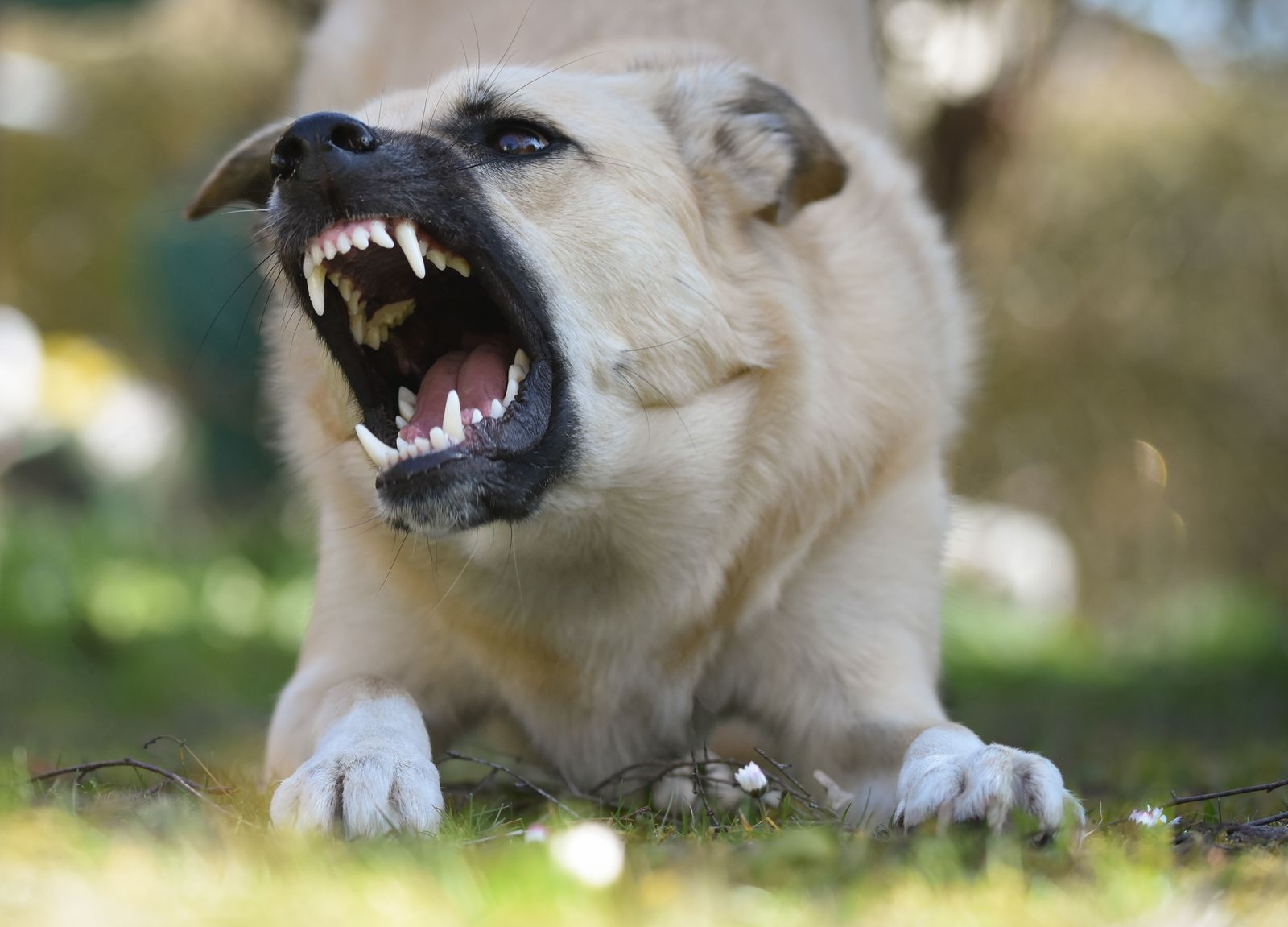
When I watch an aggressive dog, I am not watching a character flaw. I am watching a feeling that got big. Most of the aggression I see is fear that decided going first was safer than waiting, or frustration that built up with nowhere to go. A dog that lunges at the end of the lead is often a dog that wanted distance and learned that going loud makes the frightening thing move away. It worked once. It will be tried again, and it gets louder each time it works.
There is a smaller group of genuinely offensive dogs, confident and pushy rather than frightened. They are real. They are rarer than the internet thinks. And you only tell the two apart by reading the dog, not by measuring the volume.
Read the body, not the bark
An offensive dog makes itself big. The tail sits high at the base, the chest comes forward, the weight loads onto the front feet, the ears go hard forward. This dog has decided the trigger is something to be dealt with, and it has the confidence to deal with it.
A fearful dog makes itself small. The tail is low or tucked, the weight shifts back or the body crouches, the eyes widen, and under the noise there is backward movement and a search for an exit. From the front it can look like the more dangerous of the two. Read the base of the tail and you are looking at a frightened animal.
The two need opposite handling. The offensive dog needs a clear boundary. The fearful dog needs the pressure taken off. Correct a frightened dog for the bark and you have told it to stop talking, not to stop being afraid. The fear stays exactly where it was. You have only removed the warning that used to come before the teeth.
Why putting a lid on it makes a dog less safe
The instinct with an aggressive dog is to shut the behaviour down. Stop the growl. Stop the lunge. Get a sit at the door and a tidy heel past the trigger. It looks like progress, because the dog goes quiet. But a dog held in a sit is still feeling everything it felt. It is sitting on top of it. That is a lid, not a fix, and a dog wound tight as a spring underneath.
I would rather a dog be predictably grumpy than unpredictably explosive. A growl is information. A dog that has been corrected out of growling is a dog that has learned the growl gets it in trouble, so it skips the warning and goes straight to the snap. The job is not to silence the dog. It is to lower how much the dog has to be loud about in the first place.
Lower the waterline first
Every dog has a baseline level of arousal, a waterline. Triggers are the waves on top of it. An aggressive dog is usually living at high tide, so very little has to happen to tip it over the edge. Before I go anywhere near the trigger itself, I bring the waterline down.
That means looking at what is holding it up. How well the dog actually understands its world. Its health and its food, which feed mental state as much as physical condition. Whether the communication around it is clear, or a mess of repeated cues and nagging that the dog has stopped hearing. Whether its real daily needs are being met. Whether the lead itself has become a source of frustration. Whichever one is high is the one to bring down. Drop the baseline and a lot of what looked like aggression has much less to stand on.
What I withhold at the trigger
A behaviour is a feeling wearing an action. To the feeling I do not want, I give nothing: no eye contact, no talk, no touch, no treat. To an over aroused dog, every one of those is an input that says the moment is real and worth staying in. Even a correction can read as attention if the timing is wrong.
This is also why I do not push a treat at a reactive dog while it is fixated on a trigger. The food does not change the feeling. It gets paired with the trigger, and now the trigger predicts chicken, which is a problem of its own. I want a calmer dog, not a dog that is better paid for being on edge.
Give the drive somewhere legitimate to go
An aggressive dog is often a dog with real drive and nowhere allowed to spend it. I organise the day into four modes: PLAY, ANCHOR, CALM and EXPLORE, each with a clear expectation and a clear boundary. PLAY does the heavy lifting here. A dog cannot feel fear and play at the same time, so a genuine game is the fastest way through something a dog is wary of. And a dog bonded to its handler through real one on one play will choose the handler over the environment. That bond is the only reliable lever I have. Bribing is unreliable, and threatening is something I am not willing to build a dog on.
When aggression needs someone in the room
Aggression is the one area where I am careful about what a blog post can do. Reading the difference between a frightened dog and an offensive one, at distance, in the half second before it lands, is a skill that takes a person standing next to you the first few times you try it. If your dog has bitten, or is putting other animals or people at risk, that is an in person conversation.
If that is where you are, the private training program starts with me watching your dog and teaching you to read what its body is already telling you. From there the plan is specific to your dog, because a frightened dog and a pushy one do not get the same one. I work across Newport, Williamstown, Docklands and the inner west of Melbourne, and online for the parts that can be done on video.