
A dog behaviourist works out why a dog is doing something before deciding what to do about it. A trainer teaches a dog to sit; a behaviourist asks why the dog cannot settle in the first place, reads the body to find out, and changes the day so the dog no longer needs to bark, lunge or pace. That is the difference, and it is why owners who have been to two or three trainers end up with a behaviourist: the commands were never the problem.
The word is not regulated in Australia. Anyone can use it, and plenty do. So here is what it means when I use it, what it costs, and when you need a veterinary behaviourist instead of me.
Trainer, behaviourist, veterinary behaviourist: which one do you need?
- A dog trainer teaches behaviours: sit, stay, loose-lead walking, recall. Right for a dog that is basically settled and needs skills.
- A dog behaviourist works on the state underneath the behaviour: the reactivity, the anxiety, the dog that cannot switch off, the guarding, the household with two dogs at war. The tools are reading the dog, changing the structure of its week, and teaching the owner to do both. That is what I do, with a Bachelor of Veterinary Science and a Master of Early Childhood Education behind it, and fifteen years across zoos, wildlife reserves and assistance dog programs before private practice.
- A veterinary behaviourist is a vet with a further qualification in behaviour. They can diagnose medical causes and prescribe medication. In Melbourne the first consultation runs $600 to $900. You need one when the dog may be in pain or unwell, when the fear is so far over the dog's head that nothing lands, or when a vet has already suggested medication. I refer to them, and they refer to me, because medication without the lifestyle change rarely holds.
Most dogs I see do not need the vet first. They need someone to read them properly. A dog that never settles anywhere, greets its own family like strangers and responds to nothing at all is a different case, and I will tell you at the consultation if that is your dog.
What a behaviourist actually does in the first 90 minutes
Most of the consultation is reading. Your dog's natural set, the shape it holds at rest, so everything else can be read as a move away from it. Its state under a trigger: the ear position, the tail base, the weight on the front or the back legs, the mouth, the tongue. How it recovers. What it does when nobody asks anything of it. And you: how you hold the lead, when you talk, whether you tense before the dog does. I read the human through the dog.
Then I put the dog in one of five states, pressured, stressed, excited, aggressive or relaxed, and tell you which one it lives in most of the day. Nearly every problem I am hired for is a dog living in the wrong state, and the fix is bringing its baseline down: real rest, less freedom, one-on-one play, and cycles instead of walks for the first stretch. The second half of the session is hands on, with the equipment and the handling that make that possible, and you leave with the plan for the week.
What it costs, and what it is not
The consultation is 90 minutes, $400, in Newport or Docklands, at your home across the inner west, or online. If the dog needs the program, it is four weekly sessions plus my feedback on your phone videos in between, $1,600 for the four weeks, $2,000 all up. Stop after the consultation and $400 is all you have spent. I do not sell one-off sessions, because a behaviour problem is a week problem, not an hour problem, and I am not a magician. I do programs.
It is not obedience classes, it is not a group, and it is not a lifetime of management. By the end of four weeks you should be able to read your own dog and run its day, which is the point of hiring a behaviourist rather than renting a trainer.
Newport, Docklands and the inner west
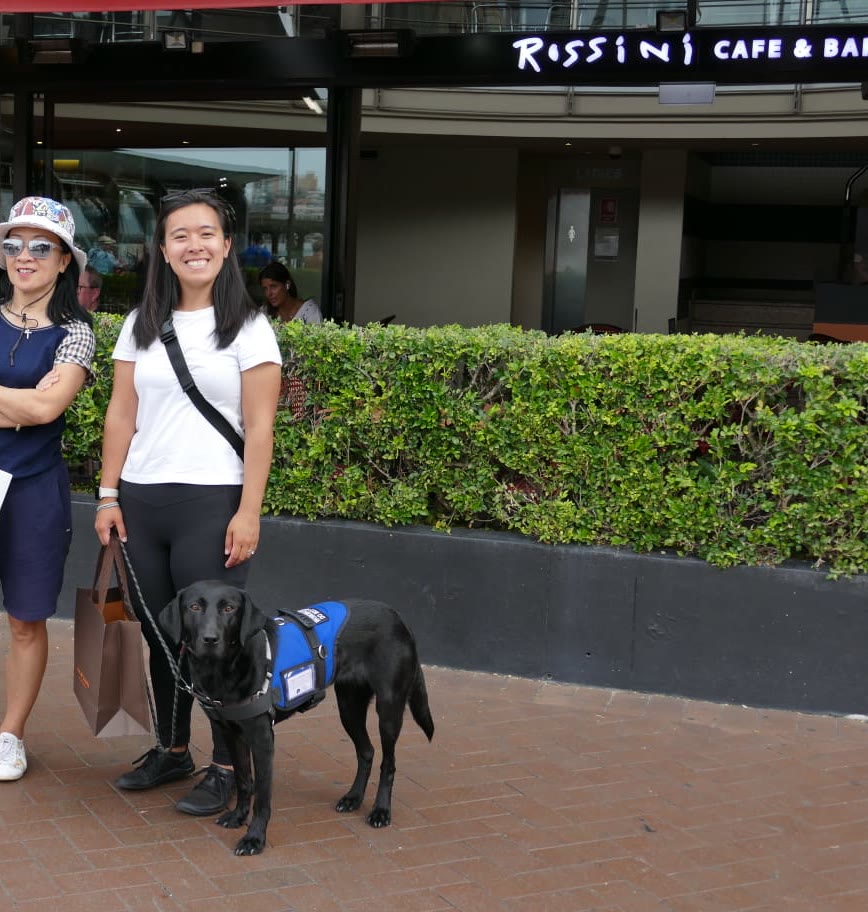
I am based in Newport. Consultations run on the streets and in the parks the dog actually uses, in Newport and Docklands, and at homes in Williamstown, Yarraville, Footscray, Seddon, Spotswood and Altona North. Murphy, my Labrador and a certified assistance dog, comes to most reactive-dog sessions. Outside Melbourne, the consultation runs online and the reading is the same.
Sessions run Wednesday to Saturday, in Newport, Docklands and inner west homes
Every enquiry starts with the form so I can read the dog on paper before I meet it. Tell me what is happening, what you have tried and who walks the dog. Fill in the form and I read it myself. Times go out in the order forms arrive.