You stop a reactive dog by changing the dog underneath the behaviour, not the behaviour on the day. There are two underlying reasons a dog reacts, and both come back to a baseline that is sitting too high: frustration, when a dog has learned to value other dogs more than it values you and the lead stops it reaching them, and fear, when a dog feels trapped on a tight lead with no way to make space. The work is the same shape for both. First you lower the baseline so the dog is not living on the edge. Then you stop feeding the reaction in the moment. Then, once the arousal is down, you deliberately work the dog around its triggers and teach it to make a better decision. Do that and the barking and lunging fade, because the state that produced them is gone.
Almost everything else sold as reactivity training is a version of managing the moment. A treat to distract, a correction to interrupt, a tool to hold the line. None of it touches why the dog went up in the first place. I have worked with over 3,000 dogs across fifteen years, and the reactive ones almost never have a training problem. They have a regulation problem, and a handler who has not yet been shown how to read it.

Reactivity is arousal, not character
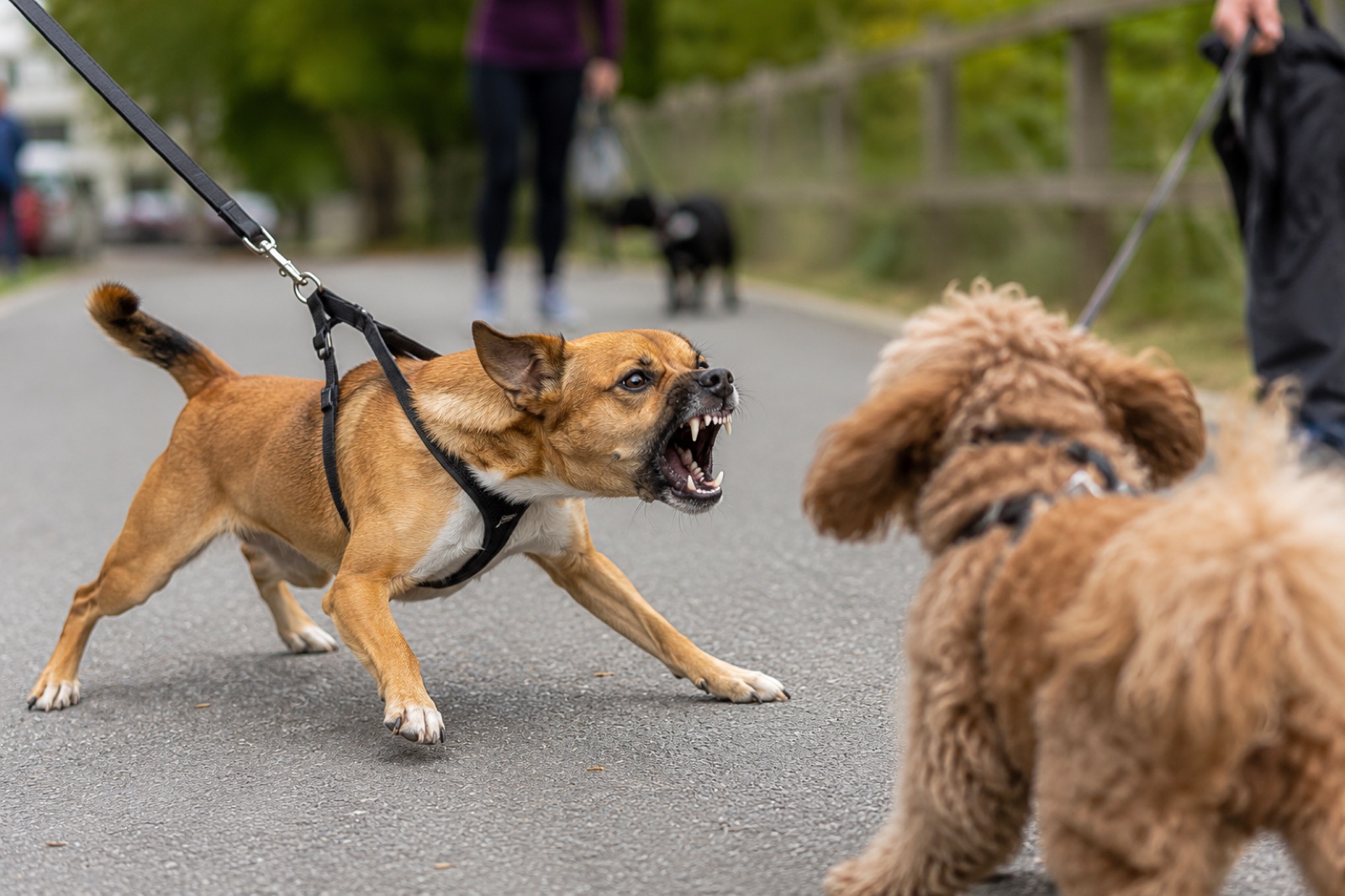
A reactive dog is not an aggressive dog or a bad dog. It is a dog whose arousal crosses a line and tips into barking, lunging, spinning, or freezing. The trigger might be another dog, a bike, a car, a person at the door. The reaction looks like it is about the trigger. It is actually about where the dog was sitting before the trigger arrived.
I use a waterline to explain this. Every dog has a baseline level of arousal, a tide line it sits at through the day. Triggers are waves on top. A dog living at high tide reacts to the seventh thing it passes because the first six already filled it up. A dog living at low tide watches the same seventh thing go by. The wave was the same size. The water underneath was not. Train the waterline down and the same triggers stop causing eruptions. That is the whole job.
This is why two dogs with the identical trigger need different work, and why the question is never just "how do I stop the barking." The barking is the last thing in a long chain. By the time you hear it, the moment to act passed several seconds ago.
I work around 350 reactive-dog cases a year in Melbourne. After four years, that is more than 1,300 dogs who lunge, bark, or never settle, and the pattern across them is remarkably consistent: 99 out of 100 are arousal problems, not obedience problems. The dog is not refusing a command. The dog is over its waterline. That is why more obedience training so rarely fixes reactivity, and why lowering the baseline does.
Frustration or fear: the two reasons dogs react
Underneath almost every reactive dog is one of two states, and sometimes both. Telling them apart matters, because the way you work each one is different.
The first is frustration, born of over-excitement. A dog that has been allowed to greet every dog on the street learns to value other dogs more than it values you. So when it sees a dog and the lead holds it back from saying hello, it boils over. The barking and lunging are a tantrum about not being able to get there. It looks like aggression. It is closer to a toddler losing it in a shop. Letting your dog say hi to everyone is how a lot of reactivity gets built.
The second is fear. A dog that finds other dogs worrying wants space, and the lead takes that option away. Often the handler makes it worse without meaning to: the moment a dog appears, the lead goes tight, and now the dog feels trapped in the situation with no way out. Trapped and afraid comes out as barking and lunging too, but it means the opposite of frustration. One of my most common fixes surprises people: your lead's not long enough. One dog is desperate to reach the trigger. The other is desperate for it to leave. For more on what is driving your dog, see why is my dog reactive.
If you are in Newport, Williamstown, Yarraville, Footscray or Seddon, here is how I run leash reactive dog training in the inner west, on the footpaths your dog actually walks.
Lower the baseline first
Before any trigger work, the daily arousal has to come down. Three things move it more than anything else.
Sleep is the first and the one owners least expect. A great many "reactive" dogs are simply overtired. An adult dog needs far more rest than most households give it, and a dog in chronic sleep debt runs hot all day. Real rest, on your terms, in a crate or on a tether, is CALM, and it does more for reactivity in the first fortnight than any drill.
Freedom is the second. A dog given the run of the house, the couch, the window, and a long walk past every trigger twice a day is a dog with too much input and no off switch. You take freedom back, not as punishment, but so the dog stops practising vigilance.
The walk itself is the third, and this is the one that surprises people. For a reactive dog I usually stop the daily walk early on. A standard walk is a messy blend of sniffing and pulling past a line of triggers the dog cannot yet handle. It is daily practice at reacting. I replace it with structured cycles at home and in quiet spaces until the dog has the regulation to handle a walk without both of you just surviving it.
Stop feeding the reaction
When the reaction does happen, what you do in that moment either feeds it or lets it pass. Most of what owners reach for, talking the dog down, locking eyes, tugging the lead, waving a treat, is an input. To the dog, an input says the moment is real and worth staying in. You think you are calming the dog. You are confirming it.
The harder, better move is to add nothing. Put your foot on the lead so the dog is safe, say nothing, and let the wave crest and fall. Then watch the recovery, because that is where the information is. I wrote the full version of this in what to do when your dog lunges and barks, and the list of the common mistakes in what not to do with a reactive dog.
Then go and work the trigger
Once the baseline is down, I do not keep a reactive dog at a careful distance forever. I do the opposite. I walk towards the trigger and challenge the dog to make a good decision, and the challenge depends on which of the two reasons is driving it.
If the dog is frustrated, over-excited about other dogs, the job is to become more interesting than the dog across the road. When you genuinely win that competition, your dog gives up on the thing it cannot reach and turns back to you, and the frustration drops on its own. You are not suppressing the reaction. You are out-competing the trigger.
If the dog is afraid, the job is to advocate for it. You show your dog that you have the situation handled, that you will make the space and see off the thing it is worried about, that you can be trusted to keep it safe. Once a fearful dog believes its handler has control, it no longer has to manage the threat itself, and the reactivity reduces on its own.
Both of these are guided work. They are what I teach inside a program, because the timing and the reading have to be right and getting them wrong sets you back. This is the opposite of avoiding the world forever. It is walking towards it on purpose, once the dog is ready for it.
Build the four modes
Lowering the baseline and managing triggers buys you a calmer dog. The four modes are what make it last. I organise a dog's day into PLAY, ANCHOR, CALM, and EXPLORE, each with a clear expectation and a clear edge. No mode matters more than the others, and a reactive dog is almost always short on at least one. Some need more genuine rest. Some need quality one-on-one play to burn the edge off and learn that you are more interesting than the street. Some have never learned to anchor to a human at all. Most of the work in a program is finding which mode is missing and putting it back, then teaching you to hold the edges so they stop blurring.
This is the difference between a dog that behaves because you are managing it every second and a dog that behaves because its needs are met and the good decision is the obvious one. The second dog is the one almost every owner is actually asking for, even when they walk in asking for obedience.
The handler is the real work
Dogs learn fast. The bottleneck is always the human. In a session I am rarely training the dog. I am showing you what your dog's body is saying moment to moment, fixing your timing, and getting you to stop negotiating with small ineffective tugs and repeated noes. A correction half a second late is a different message than one on time, and most of what owners call "my dog won't listen" is a timing problem in the handler.
My own dog Murphy, a black Labrador and certified assistance dog, comes to most reactivity sessions as a neutral dog to work around. Seeing your dog read a calm, steady dog at a workable distance teaches more in ten minutes than a fortnight of explaining can.
Can reactivity be cured?
Managed and reduced, yes. Cured, no, and you should be wary of anyone who uses that word. A dog with a low baseline, a handler who reads it, and a life built from the four modes reaches a point where the reaction is rare, short, and recoverable. Walks become walks again. Off-lead becomes possible in the right places. The dog is not a different animal. It is a regulated one. I have written more on the honest version of this in can reactivity be trained out of a dog.
It is worth saying plainly: every dog can bite. Even the most placid, saintly dog will snap, and a few will do worse, when the buttons are pushed hard enough and the arousal climbs high enough. None of that makes a dog vicious. It makes it a dog. Your dog is not a robot. Our job as owners is to read what the dog needs from us in the moment and keep the arousal low enough that it never gets to that point.
When it is bigger than a blog post
Some reactivity is beyond what reading and managing can reach: a real bite history, a dog you are frightened of, a household that is not safe. That is a point to bring in a behaviourist and, where it is warranted, your vet, because arousal that severe sometimes has a medical or medication piece underneath it. Getting help early is not an admission of failure. It is the responsible move.
And there is an honest thing worth saying plainly. If, after real effort, you come to see that you cannot give this particular dog the life it needs, rehoming it to someone who can is an act of love, not a failure. A breed-specific rescue or a calmer household can sometimes meet a dog in a way its first home genuinely cannot, and the dog can thrive there. Wanting the best outcome for the dog, even when that outcome is not you, is the most responsible thing an owner can do.
For most dogs it does not come to that. Most reactive dogs in front of me are loved, capable of far more than their owners fear, and held back mainly by a baseline nobody taught the household to lower. That is the work I do.