An anxious rescue dog is trained by bringing the fear down first, and almost nothing else, until the dog can learn. Most rescues I see in Melbourne have had a run of trainers before me, and most of those trainers started with the behaviour: the lunging at the park, the barking at visitors, the refusal to walk past the corner. The behaviour is the last thing to change. It is the dog telling you it is not coping, and you cannot train a dog that is surviving rather than learning. So the consultation starts with one question: what is this dog afraid of, and how far over its head is it?
The read most owners get wrong
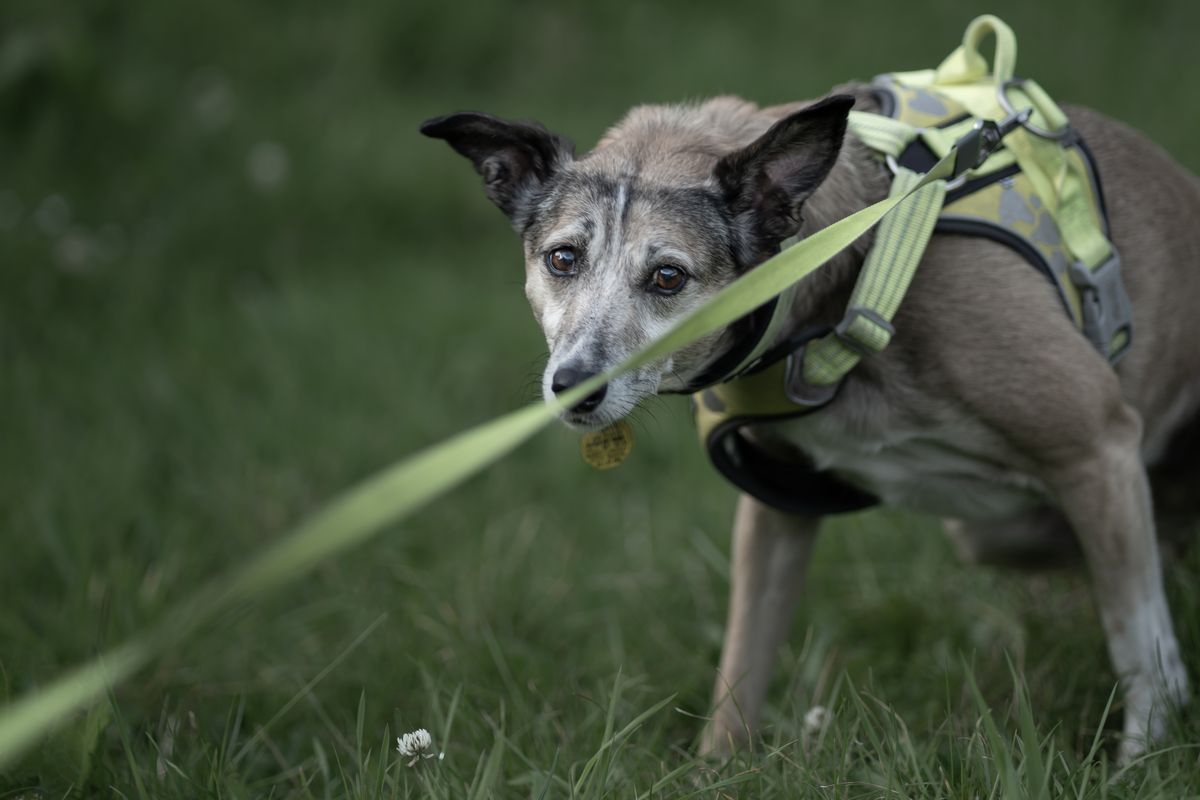
The rescue that rushes up to every dog at the park, low and wiggly, is described on nearly every intake form as "a social butterfly off lead". Then the same dog, on a lead, barks and charges at the same dogs. The owners conclude it is frustrated at being held back. It is usually the opposite. Off lead the dog can choose its distance, so it approaches to suss out a threat and leaves when it wants. On a lead it cannot leave, and a trapped, frightened dog goes on the offence. The low approach, the high manic bark, the weight leaning back, the tucked tail base: that is fear dressed as friendliness. Treat it as frustration and you will spend months making the dog braver in exactly the wrong direction.
The other common misread is anxiety that is not anxiety. A big young rescue, adopted at four months, bounced through foster homes, now explosive at every dog and screaming in the car, arrived with a diagnosis of anxiety and four months of snuffle mats and "go find" for it. What I saw in the first ten minutes was a play-driven dog that had not played in a year. Frustration, not fear. The treatment is the opposite. Reading which dog is in front of you is the whole first session.
What a rescue missed, and what it costs
A dog that did not get the first eight weeks with a good breeder, and then lost its first year to a shelter or a chain of homes, missed the window where a puppy takes the world in: wind, rain, wet grass, textures, traffic, umbrellas, the sound of a lift. That dog takes longer with every new thing, and the work is to show it the world without overwhelming it. It is not a broken dog. It is a dog that starts from further back, and the timeline is honest about that.
Some rescues are also over their head. Most dogs explode at a hundred; a few explode at two hundred, and above about eighty they cannot feel anything. No correction lands, no treat lands, the nose bleeds from the blood pressure. That dog is not learning. That dog gets a different protocol entirely: a long line, nothing taught in the session except that tension on the lead means something good is coming, and the only score that matters is the recovery curve. Two hundred and back to eighty. Then one eighty. Then lower. Everything else arrives as a by-product once the fear comes down.
The plan for an anxious rescue
- Control first. The dog cannot get loose, cannot chew through a lead, cannot drag you over. Until that is true nobody can read anything, including me.
- Then your own arousal. A tense handler makes a tense dog, and a rescue owner who has been told by a neighbour to put the dog down is usually very tense. I read you through your dog, and I say what I see.
- Sleep, rest and less freedom. The couch, the window and the run of the house go for now. Rest on your terms in the busiest room, so the dog learns to switch off inside the noise.
- Play through the scary bits. A dog cannot feel fear and play at the same time, so play is the fastest way through something the dog is wary of, provided the fear is below panic grade. Above it, the fear comes down first.
- You take point. A fearful dog on the front line has to fight threats off itself. When it trusts that you have it, its weight comes down and the offence goes. That is the whole reason for the equipment and the handling.
- Map the triggers, then dose the venue. Most intense rescues are precise about what frightens them: children but not adults, statue-still people, men in hats. Once the hierarchy is mapped, I pick locations by which tier they serve and how much, so the dog is stretched without being flooded.
The consultation is 90 minutes, $400. If the dog needs the program, it is four weekly sessions with my feedback on your videos in between, $1,600 for the four weeks, $2,000 all up. Rescue programs sometimes run six lighter sessions instead of four heavy ones, and I will tell you at the consultation which yours is. I judge the week, not the moment: the dog that sleeps from session to session, falls asleep in the car on the way to training and rides home quiet is a dog whose waterline is dropping.
Rescues in Melbourne's inner west
I work from Newport, with Docklands as the second base and home visits across Williamstown, Yarraville, Footscray, Seddon, Spotswood and Altona. Many of my rescue clients come from the shelters and rescue groups on this side of town and from interstate transports, and a fair number are second or third owners. If you are outside Melbourne the consultation runs online, and the reading is the same.
Sessions run Wednesday to Saturday, in Newport, Docklands and inner west homes
Rescue consultations are longer on the reading and shorter on the doing, on purpose. Bring the adoption paperwork, whatever the rescue told you, and the gear the dog came with. Fill in the form and I read it myself. Times go out in the order forms arrive.