
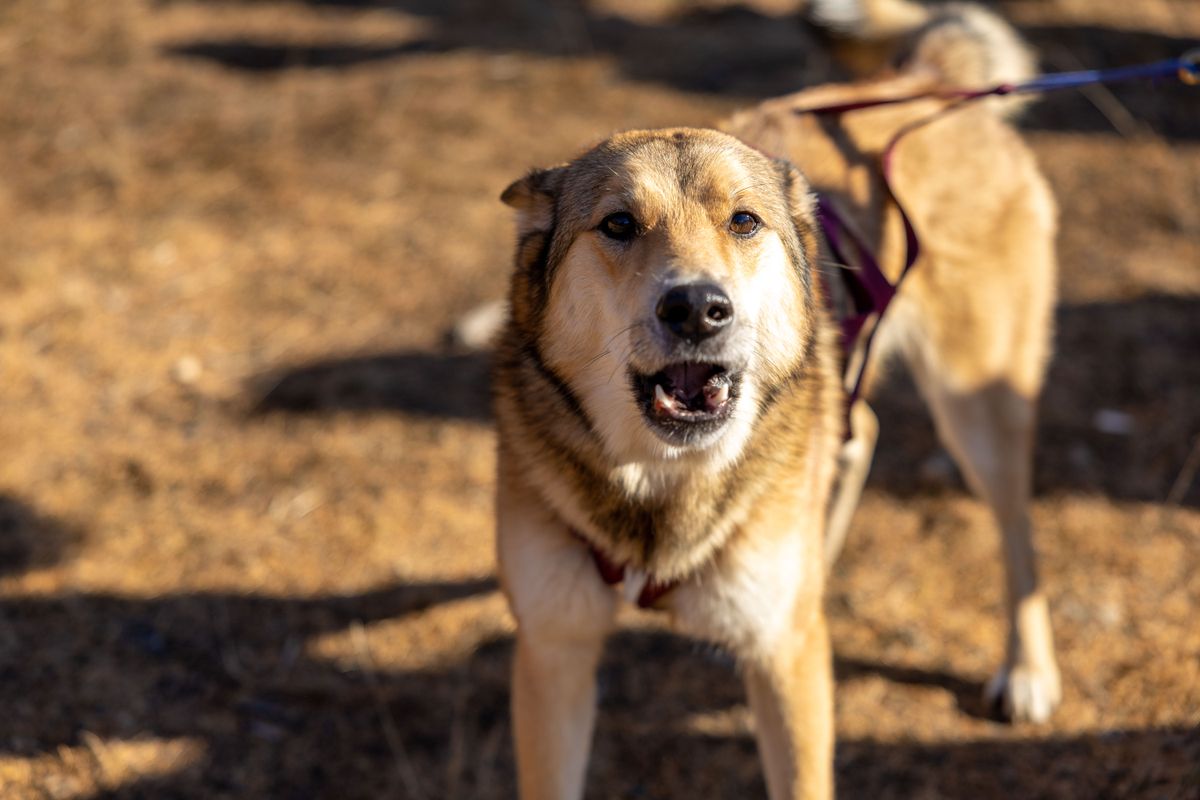
A dog growls at strangers to ask for distance. It is not an attack and it is not disobedience. It is your dog telling you, and the stranger, that it is uncomfortable and wants space, using the politest tool it has left before things get physical. That makes the growl information. What you do with it decides whether your dog ever needs anything louder.
I know how it feels from the other end of the lead. A growl at a visitor or a passer-by is embarrassing, and the first instinct is to shut it down fast. Hold that instinct, because it points at the one thing you must not do.
Never punish the growl
The growl is the warning light on the dashboard. Punish it and you have not fixed the engine, you have unplugged the light. The discomfort stays exactly where it was. What disappears is the warning, and a dog that has learned growling gets it into trouble goes quiet and, when it finally runs out of room, skips straight to a snap. Almost every "he bit with no warning" story I hear started with a growl that was corrected out of the dog somewhere in its history. It sits at the top of my list of what not to do with a reactive dog for a reason.
A growling dog is a dog still talking to you. Keep it that way.
What the growl is actually about
Underneath, it is nearly always fear. The dog wants the stranger further away and has no other way to arrange it. And it is often oddly specific: men with beards, people in hats or hi-vis, someone with a walking stick, children that move fast. Owners read the pattern as random. It rarely is. A puppy's early weeks build its picture of what a normal human looks like, and anyone outside that picture reads as a glitch. Glitches feel dangerous.
Whether that discomfort becomes a growl on a given day is set less by the stranger and more by your dog's baseline. Every dog carries a waterline, a level of arousal it lives at when nothing is happening. A dog running high, under-slept and over-stimulated, has no room left when an unfamiliar man fills the doorway. The same dog after a genuinely balanced week watches him arrive and stays in its own body.
Why some strangers and not others
Watch what the growled-at people do, not just who they are. Most of them loom. They approach head-on, hold eye contact, bend over the dog and reach for the top of its head, which in dog language is about as polite as a headlock from someone you have never met. The strangers your dog is fine with are almost always the ones ignoring it.
That gives you the most useful sentence in this whole post. When someone approaches, say "please ignore him." Not "he's friendly." A stranger who does not look, does not talk and does not touch stops being a problem your dog has to solve.
The build before the growl
By the time you hear the growl, your dog has usually been talking for a while. Ears drifting back, mouth closing from soft to tight, weight shifting away, a head turn, the white of the eye showing. Learn to read the body language and you can make space at the head-turn stage, before the dog has to raise its voice. Miss it, and the growl does the job the quieter signals should have done.
I work around 350 reactive-dog cases a year in Melbourne. After four years, that is more than 1,300 dogs who lunge, bark, or never settle, and the pattern across them is remarkably consistent: 99 out of 100 are arousal problems, not obedience problems. The dog is not refusing a command. The dog is over its waterline. That is why more obedience training so rarely fixes reactivity, and why lowering the baseline does.
What to do in the moment
Make space first. Move your dog away calmly, without commentary, to a distance where its body softens. Then stay neutral. Do not coo "it's okay, it's okay," because reassurance tells the dog the thing is worth worrying about, and do not scold, because the growl was the correct behaviour. Your job is to be the one in the room whose body says nothing is happening here. And manage the stranger, which is usually the harder animal to train. Plenty of people will announce "dogs love me" while doing everything your dog just asked them not to do. You are allowed to step in front and say no.
Growling at visitors at home
The doorbell version of this has an extra ingredient: the stranger is inside the den and staying. Do not make the dog say hello. A forced greeting is pressure on a dog already out of room. Give it CALM instead, a crate or tether away from the door, and let the visitor become boring background. The visitor's job is to ignore the dog completely. No eye contact, no talk, no touch, no treats. If the dog settles and chooses to come and investigate, on its own timeline, lovely. If it settles and stays put, that is a fine outcome too. Being allowed not to interact is exactly what your dog was asking for.
The longer fix
The lasting work is not about strangers at all. It is bringing the waterline down, real rest, structure in place of chaos, and far fewer rehearsals of the growl, then letting your dog take people in from distances it can handle without being made to interact. The same baseline logic that drives reactivity drives this.
One thing I do not do is ask strangers to feed your dog. A fearful dog lured a metre closer by a treat is a dog in conflict, now nearer the thing it fears with less room to get out. I would rather your dog learn that strangers are background noise, not threats and not vending machines. The full approach is in how to stop a reactive dog, and if the growling comes with lunging or snapping, or there are children in the mix, bring in a professional rather than working it alone.
Common questions
Does growling mean my dog is aggressive?
No. It means uncomfortable. A dog that growls is still giving warnings, which is exactly what you want. The genuinely dangerous dog is the one that has learned to skip them.
Should I punish my dog for growling?
No. You would be removing the warning, not the feeling. The discomfort stays, and the next stranger may get the snap instead of the growl.
Why does my dog only growl at some people?
Usually the ones outside its early picture of a normal human, and the ones whose approach is rude in dog language. Watch what the growled-at people have in common. The pattern is rarely random.