Training a cattle dog means giving a control freak somewhere to put it: proper play with you for the chasing and nipping, brain work for the watching, and an off switch, because most of what owners call bad behaviour is herding with nothing to herd.
Blue heeler, red heeler, Queensland heeler and Australian Cattle Dog are all the same dog in different words. It was bred to move cattle over long days by nipping at their heels, and nobody told it that it now lives in Melbourne.
All herding dogs are control freaks
I say this to every cattle dog owner. If they're not control freaks, they can't be herding dogs. They want everyone together, and they want to know where everyone is going.
So you and your partner walk in different directions at the park and she cries after whoever left. She follows you to the toilet. You put her in the crate, walk out, and she screams. A lot of people call that anxiety. A lot of the time it's closer to "how dare you leave me".
Is it drive or is it fear?
You need to know this first, because the two get different answers. Plenty of cattle dogs have both.
Ask yourself one thing. If there's a lion, do you walk towards it? A dog that charges the vacuum, the lawnmower, the scooter or the bike isn't scared of it. That's drive. A dog that backs up first, then barks once the thing gets closer, is telling you something else. The bark helps too: the low one is usually "what's going on?", and the high-pitched one is usually "let me at it".
Drive doesn't get desensitised away. My drive is talking about dogs. You can talk to me about dogs at 2am for the rest of my life and I'll never get bored of it. But when I've had a good day of it, I can have dinner with my husband and not mention one dog.
Give the chasing somewhere to go
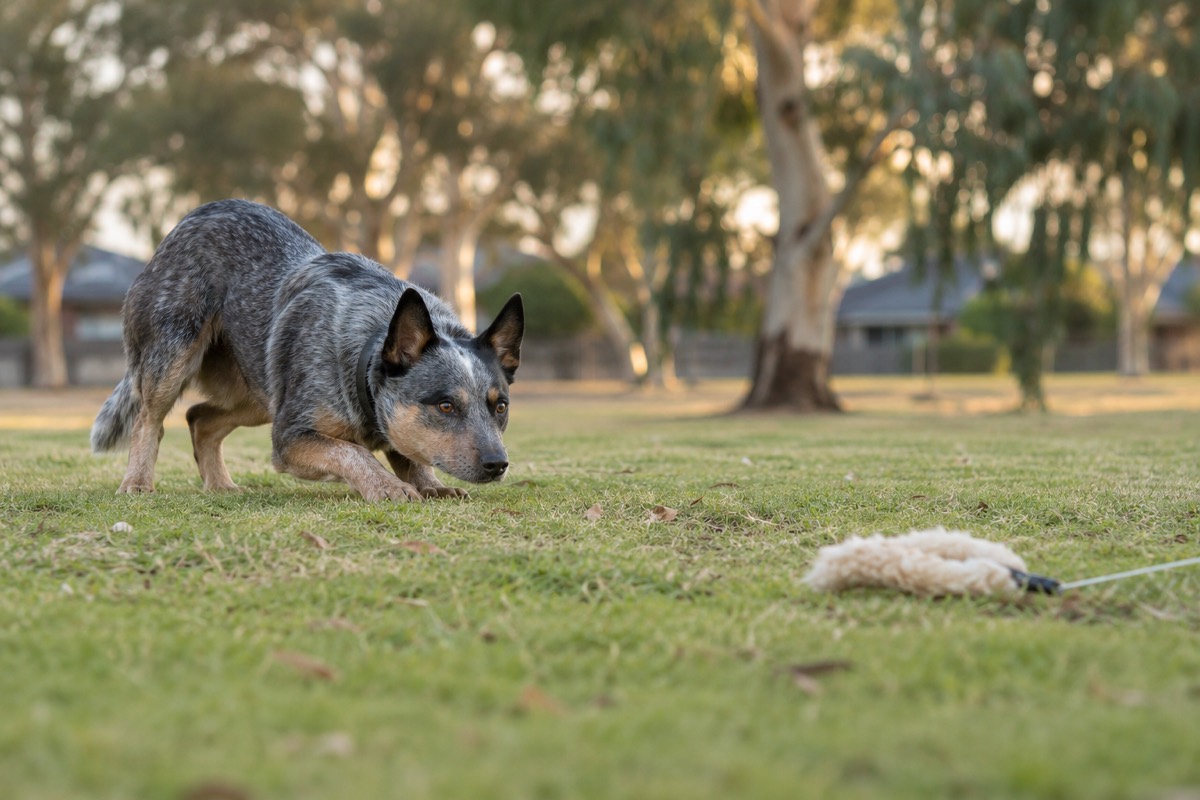
This is PLAY, and it's why I like a flirt pole for this breed. Keep it low and move it like a rabbit: it stops when she stalks, and it takes off when she pounces. Don't swing it in circles. Say "ready" to start and "finish" to end, so the game runs on your terms.
Now her chase has a job, and her fear drops as well, because a dog can't feel fearful and playful at the same time. That only works below panic. If she's already over her head, wait for her to come down first.
If she's nipping children, please don't try to sort that out with a toy. Keep the kids and the dog apart for now and get someone in to look at it in person.
What doesn't help
Longer walks. Your cattle dog is an athlete, and two long walks a day just build a fitter dog who still can't switch off.
Snuffle mats and treat hunts don't help either. That's a dog entertaining itself, with no engagement from you, and I've written about it in enrichment toys. What does tire this dog out is short cycles of PLAY, ANCHOR and CALM, several times a day.
If yours is a rescue
A rescue may have missed out on the world early, so every garbage truck and helicopter is news. It's like a kid who never got taken to Melbourne Zoo. We show them the world, a bit at a time, from car parks and side streets. It takes a little longer, but it's doable.
A rescue might also be very polite for the first few weeks. That's often shutdown. Once they're comfortable and work out that lunging makes people go away, you meet the real dog.
If this sounds like yours, the private training program starts with a consultation so I can see what's drive and what's fear. I work across Newport, Williamstown, Docklands and Melbourne's inner west, with online support between sessions.