
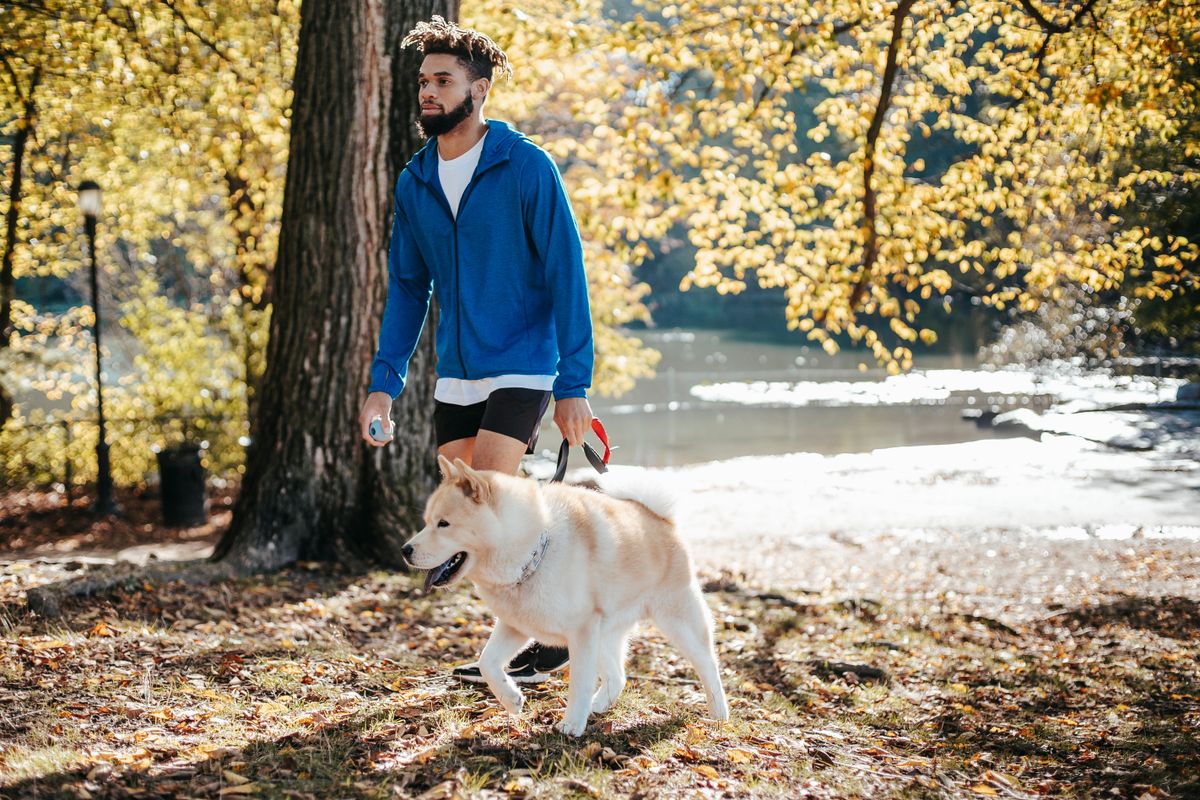
Walking away from an off-lead dog is not avoidance. It is advocacy, and your dog reads it exactly that way, on one condition: they must never feel your panic while you do it.
Owners fight me on this one. "If we always leave, isn't he learning to run from his problems? Shouldn't he learn to cope?" No. He is learning something much better: when trouble shows up, my human handles it, and nothing bad reaches me. That lesson compounds. Every calm exit is money in the account, and a dog with a full account stops needing to solve problems with his teeth.
The bulletproof car
Here is the picture I give clients. When you and your dog leave together, calmly, you are driving a bulletproof car through the situation. The other dog can be loose, rude, completely out of control, and it does not matter, because you are both inside the car. Completely protected.
But the car is only bulletproof if you drive it like it is. The moment you snatch the lead, gasp, and drag your dog off at a sprint, you have told your dog the armour is fake. Now they know: when another dog appears, my human falls apart, so this must be as dangerous as I thought. You can walk away a hundred times and still make things worse if all hundred were panicked.
So the exit is boring. You see the dog, you turn, you leave at a normal pace, breathing like a person who has somewhere mildly interesting to be. Boring is the whole point.
You have three options. Pick the third.
When an off-lead dog appears, handlers do one of three things. They avoid, spiralling into panic mode and transmitting it straight down the lead. They blame, squaring up for a fight with the other owner while their own dog loads up beneath them. Or they get curious: foot on the lead, do nothing for a beat, and read. What is that dog actually doing? Ambling and sniffing, or locked on and coming?
Curiosity is the trained response. Most off-lead dogs are not coming for you, and a handler who reads before reacting leaves calmly when leaving is right, instead of fleeing every dog-shaped object at the far end of the park. Your dog notices the difference. Dogs always know whether you are scanning the world at a seven while they sit at a two.
Afterwards: study from safety
"Read the dog, not the park."
Leaving does not have to mean the lesson ends. Once you have distance and your dog is settled, if the situation allows, stop and let them watch from safety. Sit on the grass fifty metres away and let your dog observe the loose dog being a dog. This is where the learning actually lands: that thing existed, we handled it, and now we can look at it without the world ending.
Then carry on with your walk and act like nothing happened, because nothing did. That is the story you want your dog to keep.
You did not fail today by leaving the park. You advocated, and your dog banked it.
If off-lead dogs are the moment your walks fall apart, the free On-Edge Audit will tell you where your dog sits in two minutes. And if the reactions run deeper than one scenario, that is what my private reactive dog programs are for.