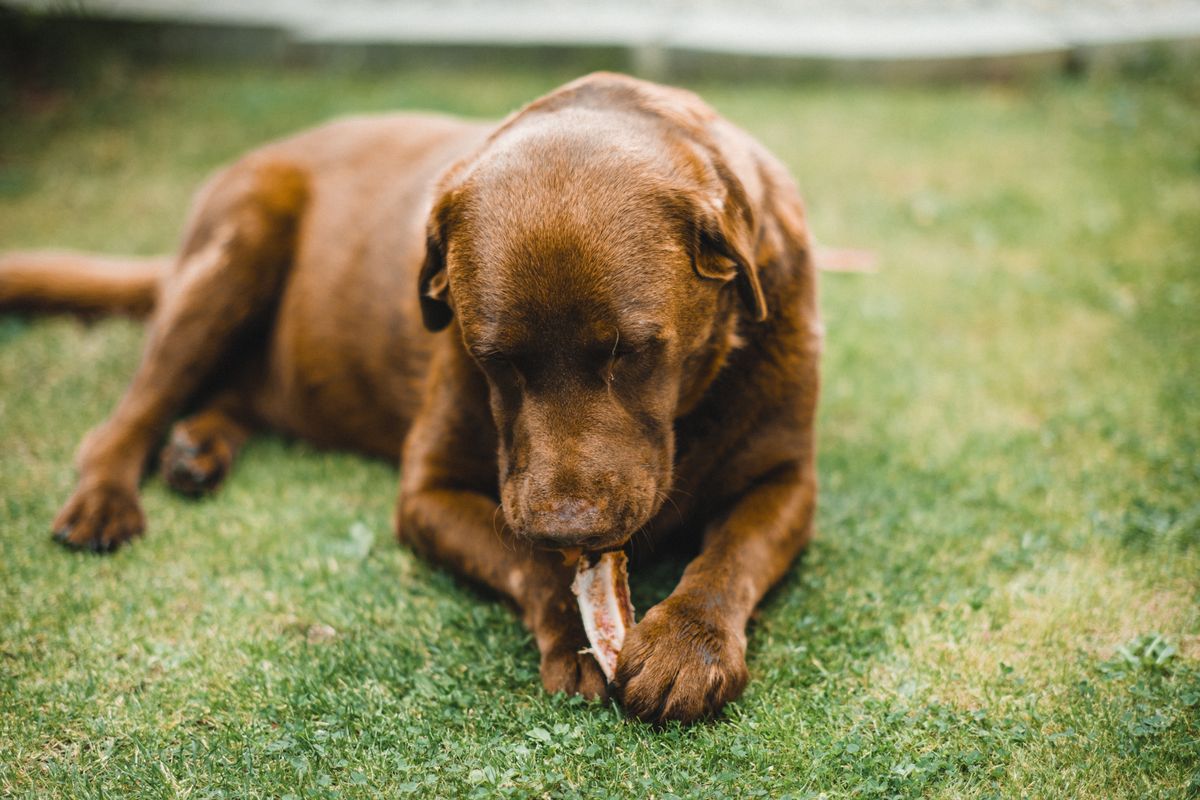
A dog stiffens over its bowl. The eating slows but does not stop. The head drops a little lower, the body curls a little tighter around the food, and if you take one more step there is a low sound you have not heard before. Most owners read that as the dog turning on them. It is not. It is a dog telling you, in the only language it has, that it is worried about losing something it values.
Resource guarding is normal. A dog that protects food, a bone, a toy, a spot on the couch or even a person is doing something every animal that ever had to compete for resources is built to do. It becomes a problem when the guarding is out of proportion to any real threat, and when the human response makes the dog more worried rather than less.
The body language comes before the growl
The growl is late. By the time a dog growls it has usually already told you several quieter things, and the work is to catch those. A dog that is starting to guard will freeze, the chewing or eating pausing for a beat while everything else holds still. The head lowers over the item. The eyes go hard, often with a flick of white as it tracks you without moving its head, the whale eye. The body stiffens and curves around the resource, what I call the sea-curve, the dog physically wrapping itself around the thing it does not want to lose.
Read those and you never need to get to the growl. The freeze is the moment to notice. A dog that has learned the freeze and the growl both get ignored, or worse, punished, is a dog that stops offering them and goes straight to the snap. That is how a guarder becomes a biter with no warning.
Why taking the bowl away makes it worse
The most common advice is to take the food away to show the dog who is boss. Stick your hand in the bowl. Prove you can. It is the worst thing you can do. A dog that is already worried about losing its food, and then has its food taken by the very person it was worried about, has just had its fear confirmed. You have not taught it that you are safe. You have taught it that you are exactly the threat it suspected, and that it had better be faster and louder about it next time.
The same goes for punishing the growl. A growl is information. I would always rather a dog that warns than one that has been taught warnings get it in trouble. Suppress the signal and the feeling underneath is still there, sitting under a lid, waiting for the moment the lid slips.
Lower the guarding, do not fight over the resource
The real work is not at the bowl. It is in the dog's baseline. A dog living high on its waterline, already tense before the food arrives, guards more than the same dog living calm. So I look at the whole picture first. Is the dog resting enough. Is it over-aroused from too much of the wrong kind of stimulation. Is food scarce or unpredictable, because scarcity breeds guarding, and a dog that trusts food keeps coming is a dog with less to protect. Is mealtime happening in a settled state, or in a scramble of excitement.
From there it is mostly about not being the thing that takes. I stop hovering and looming over a dog while it eats, because standing over a worried dog is pressure it does not need. I let eating happen somewhere the dog feels secure, often in CALM, on a tether or in a crate, where the routine itself lowers arousal and nobody is going to reach in. And where I do approach, I become a dog that adds rather than subtracts, so my arrival near the bowl predicts something good arriving too, not the bowl disappearing. Over time the dog stops bracing for loss.
Through all of it I give the guarding feeling none of the four things it feeds on: no eye contact, no talk, no touch, no reaching in. A behaviour is a feeling wearing an action, and the feeling here is worry about loss. You answer it by making loss stop happening, not by proving you can win.
When guarding needs a person in the room
Guarding around people, especially children, and any guarding that has already involved a bite, is not a blog-post problem. The reading happens in fractions of a second and the cost of getting it wrong is high. If your dog is guarding from family members, or you have kids in the house, get a professional in before you work on it yourself.
If that is where you are, the private training program starts with me watching your dog and teaching you to read the freeze before the growl. I work across Newport, Williamstown, Docklands and Melbourne's inner west, and online for the parts that suit it.