
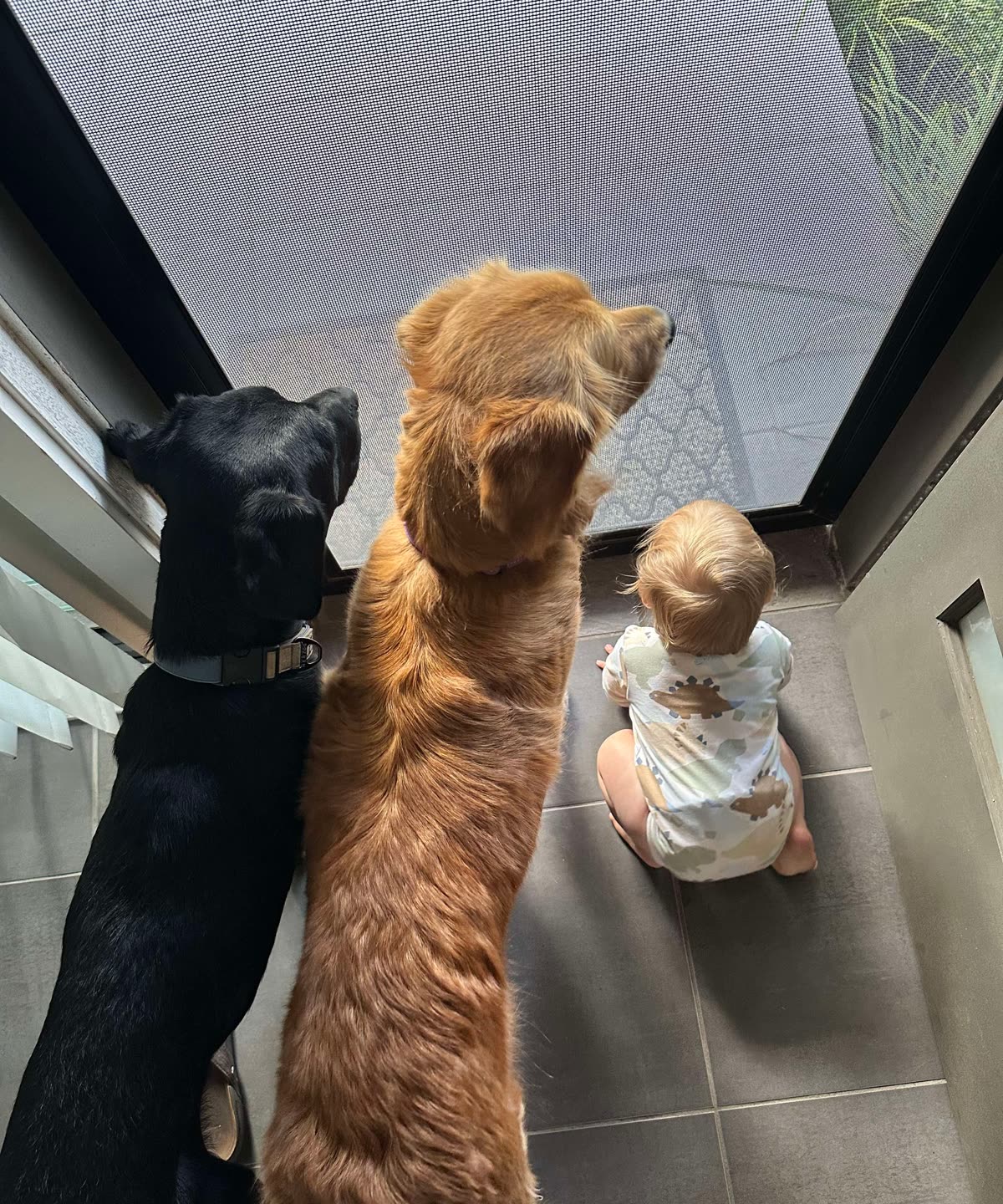
You prepare your dog for a baby by starting months before the due date: build the crate stamina, the daily routine, and the four modes now, so that when your attention halves overnight, your dog's world doesn't change at all. The goal is a dog for whom the baby's arrival is a non-event. That is completely achievable if you start early.
I get this call a lot. Clients expecting their first baby, a dog somewhere between slightly wired and full teenager, and a due date circled on the calendar. A due date is the best training motivation I have ever seen. Use it.
You're preparing for the wrong thing
Most baby-and-dog advice has you preparing the dog for the baby. Play crying sounds off YouTube. Carry a doll around the house. Bring a blanket home from the hospital for the dog to sniff. I understand why people do it, but it's the wrong project. Your dog doesn't need to meet the baby early. Your dog needs to cope with getting less of you. The baby is not the problem. The attention drop is.
A dog who gets 100% of your attention today and 30% of it the week the baby comes home is the dog who starts barking at the fence, whinging outside the nursery and dismantling the couch. Not because of the baby. Because nobody taught him how to be off duty. So the preparation isn't introductions. It's structure.
Your baby is going to be a potato
Here's the good news, and I say it to every expecting couple: your baby, no offense, is going to be a potato. Newborns don't run, don't grab tails, don't tear through the house. For months, your baby sleeps, eats and gets carried from room to room. A potato with a schedule.
That potato window is your runway. Your dog doesn't have to learn to live with a toddler yet. He just has to learn that a small new human exists and life carries on as normal. If the routine went in before the birth, the dog spends the potato months practising it while the stakes are low. By the time the potato learns to crawl, the structure is old news.
Active baby, passive dog
One rule runs the whole household from day one. Active baby, passive dog. Active dog, passive baby. When the baby is awake, being fed, being carried, being admired by the grandparents, the dog is in CALM: crate or tether, switched off, not part of the event. When the baby is asleep, the dog gets his turn. A proper play session, a training cycle, your full attention. You run one at a time. You never referee both at once.
This is why crate stamina is the most useful thing you can build before the due date. Start at ten minutes. Build to an hour. Then keep going until your dog can hold six hours in one stint, because newborn days are long and they don't check your dog's schedule. A dog who can only settle for twenty minutes is a dog you'll be managing on no sleep. If your dog can't settle at all yet, start there.
The other half is cycles. Short structured sessions, 15 to 20 minutes, three or four a day, whoever has free hands does the next one. Cycles are exactly what a newborn schedule can absorb, which is why I install them months out. Build them now, while you still have two free hands and a full night's sleep, and they'll still be running when you don't.
The crying baby myth, reversed
Everyone tells me the same thing. My dog will know when the baby cries. He'll be worried. He'll want to help. No. Your dog could not care less about the crying. What revs your dog is you. The baby cries, two adults launch off the couch, everyone moves fast, voices go up. From the dog's side of the room: everyone's up, everyone's rushing, this must be an emergency, I'd better bark. You revved him. The baby just supplied the soundtrack.
The baby's noises are none of your dog's business. And they stay that way because of how you behave, not how he does.
So when the baby cries, one of you gets up calmly and deals with it, and the dog gets nothing. No eye contact, no "it's okay", no drama. What you don't make a big deal of, your dog learns not to make a big deal of either.
Do the toy audit now
Go through the dog's toy box before the due date. Anything with a face goes. If a toy looks like something a child would want, it is a child's toy, because your child won't know the difference. A three year old wants the cute plush hedgehog and could not care less about a rope. So the rope is the dog's, and the hedgehog was never going to end well.
Squeaky toys go too. Squeaky toys sound exactly like the squeaky shoes children wear, and like half the baby toys you are about to be given. A dog who has spent two years learning that squeak means mine is in for a very confusing first birthday party. What survives the audit is a plain rope and a decent tug, and that's plenty. It's not about the toy. It's about how you play with your dog.
The dogs who don't blink
The dogs who sail through a baby's arrival are the ones who already live on the four modes. PLAY, ANCHOR, CALM, EXPLORE. The modes don't shift when the household changes, and that is the whole point of them. The baby comes home and, from the dog's side, nothing structural happened. CALM still means switch off. PLAY still happens, shorter some days, but it happens. The rules didn't move, so the dog has nothing to renegotiate while your hands are full.
And years from now, when your potato turns into a child who wants to hold the lead, I have a whole system for that too: child-sized grips, a knot in the lead at their height, food games instead of tug. Not today's problem. Today's problem is a crate, a toy box and a calendar.
If your due date is set and your dog is nowhere near any of this, come and see me early. A private session is $400 for 90 minutes and we build the whole pre-baby routine in one go. Six months out is comfortable. Three months is workable. The week the capsule goes into the car is not.