
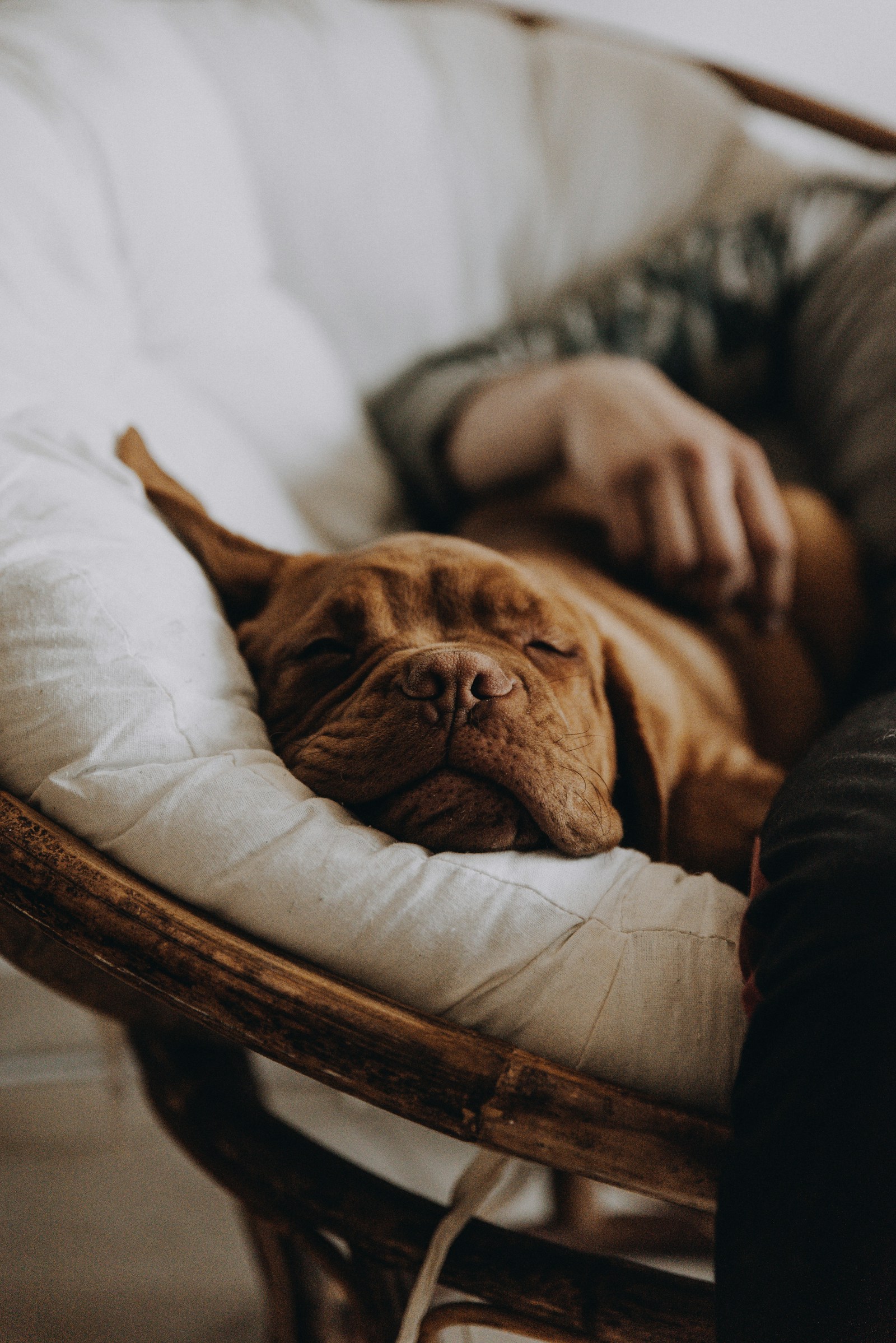
If your dog won't settle down, the most common reason is not that it needs more exercise or that it is being difficult. It is that the dog is overtired and over-aroused, sitting too high on its baseline to switch off, and it has never been taught that rest is something you do on purpose rather than something that happens once you are exhausted.
That is the short version, and it runs against the usual advice. Most owners with a dog that won't settle are told the dog needs a longer walk or a harder run. Sometimes that buys you an hour. More often it makes the evening worse, because you have taken an already wound-up dog and wound it up further. A tired dog and a settled dog are not the same animal, and chasing the first one will never reliably give you the second.
The wired-tired dog
A dog that cannot settle is usually a dog past its own bedtime. Think of a toddler who is overtired: not calm and sleepy, but frantic, clingy, and impossible to put down. The dog paces, whines, follows you from room to room, grabs a sock or a shoe, jumps up, lies down for ten seconds and then springs up again. Owners read all of that as a dog with energy to burn. It is the opposite. It is a dog with an engine it cannot turn off, and every extra thing you give it to do keeps the engine running.
This is the single most common thing I see across every age and breed. The tell is that the dog looks busy and restless rather than heavy and slow. A genuinely under-exercised dog is a rare thing in the homes I visit. A wired-tired one is in most of them.
What the day does to the waterline
Every dog has a baseline level of arousal, a waterline, and everything that happens through the day pushes it up. The walk, the visitor at the door, the bin truck, the game of fetch, the kids coming home from school. Each one is a small wave. If the dog never gets all the way back down to flat in between, the waves stack, and by the evening the dog is sitting at high tide with nowhere left to go. That is the witching hour so many owners describe, when the dog is wired, mouthy, and reacting to things it happily ignored in the morning. You can read more about that pattern in the waterline model at the bottom of this page.
So a dog that won't settle in the evening is often not misbehaving at 8pm. It is showing you the sum of a day that had no proper rest built into it.
Settling is a skill, not a mood
Here is the reframe that changes everything for owners: settling is a skill you teach, not a mood you wait for. Most people wait for the dog to run out of steam and call that settling. What you actually want is a dog that can switch off on purpose, even when it is not exhausted and even when the house is busy. That is CALM, one of the four modes, and it is the one most restless dogs are short on.
You teach it deliberately. The dog rests in a defined place, on a tether or in a crate, where demanding behaviour gets nothing and only a settled dog gets released. The point is not the length of time. The point is that the dog learns rest is available on request, not something it has to earn by collapsing. The test I use is the cafe: can your dog switch off under your chair while you have a coffee, in a place full of movement and smells? A dog that can do that has learned to settle. A dog that only settles once it is wiped out has not.
Give the restlessness nothing
When the dog paces, whines, paws at you, or brings you a toy at 8pm, it is asking you to turn the arousal back up. The mistake is to answer it. To an over-aroused dog, eye contact, talking, touch and treats are all inputs that say the moment is worth staying in, and even a sharp "settle down" reads as you joining in. So you give none of it. No eye contact, no talking, no touch, no treat. The moment the dog gives up and lies down of its own accord is the moment it earns your attention. You are not ignoring the dog. You are answering the calm instead of the noise.
What not to do
Do not add a second walk at night to tire the dog out. Do not fuss over the restlessness or reassure it, which tells the dog there is something to be unsettled about. And do not stand over the dog issuing "sit", "bed", "settle" on repeat, because that is managing the surface and it leaves the arousal underneath exactly where it was. A dog put in a down while it still feels wired is a lid on a boiling pot, not a calm dog.
The order that works
Protect the dog's rest and sleep first, because an overtired dog cannot be taught anything. Lower the daily input so the waterline has a chance to come down between events. Teach CALM in a defined spot so the dog has a real answer to the empty afternoon. Give the pacing and demanding nothing, so it stops paying. Then give it a couple of weeks. The baseline drops, the evenings get quiet, and the dog you were told needed more exercise turns out to have needed more rest.
Common questions
Should I exercise my dog more so it's tired enough to settle?
Usually no. A walk is stimulation, not rest, and a dog that can't settle is more often over-aroused than under-exercised. Adding a second walk at night takes an already wound-up dog and winds it up further, which is why so many owners report the evenings are the worst part of the day. A tired dog and a settled dog are not the same animal. The fix is teaching rest, not adding more to do.
Why won't my dog settle in the evening specifically?
Because arousal accumulates. Every walk, visitor, noise and game through the day is a small wave, and if the dog never gets all the way back down to flat in between, it arrives at the evening sitting high on its baseline. The evening witching hour is not a behaviour problem, it is the day catching up. Protect rest earlier and lower the daytime input, and the evenings come down with it.
Is using a crate or tether to teach settling cruel?
No, when it is done properly. A crate or a tether gives the dog a clear, defined place to rest where demanding behaviour gets nothing and only a settled dog gets released. That is how a dog learns to switch off on purpose rather than only collapsing when exhausted. It is a rest spot, not a punishment, and most dogs come to take themselves there once they understand it.
How long does it take to teach a dog to settle?
The skill starts within a few days if the whole household holds the line, but the baseline usually takes a couple of weeks of consistency to come down. The dog has often spent months learning that pacing and demanding gets a response, so it takes a little while of that no longer working before rest becomes the default.
My dog settles when it's tired but not when I need it to. What do I do?
That is the difference between collapsing from exhaustion and CALM as a taught skill. You want a dog that can switch off on cue even when it isn't tired and the house is busy, which is the cafe test. Teach settling deliberately on a tether or in a crate, so rest becomes something the dog can do on request rather than something that only happens once it is wiped out.