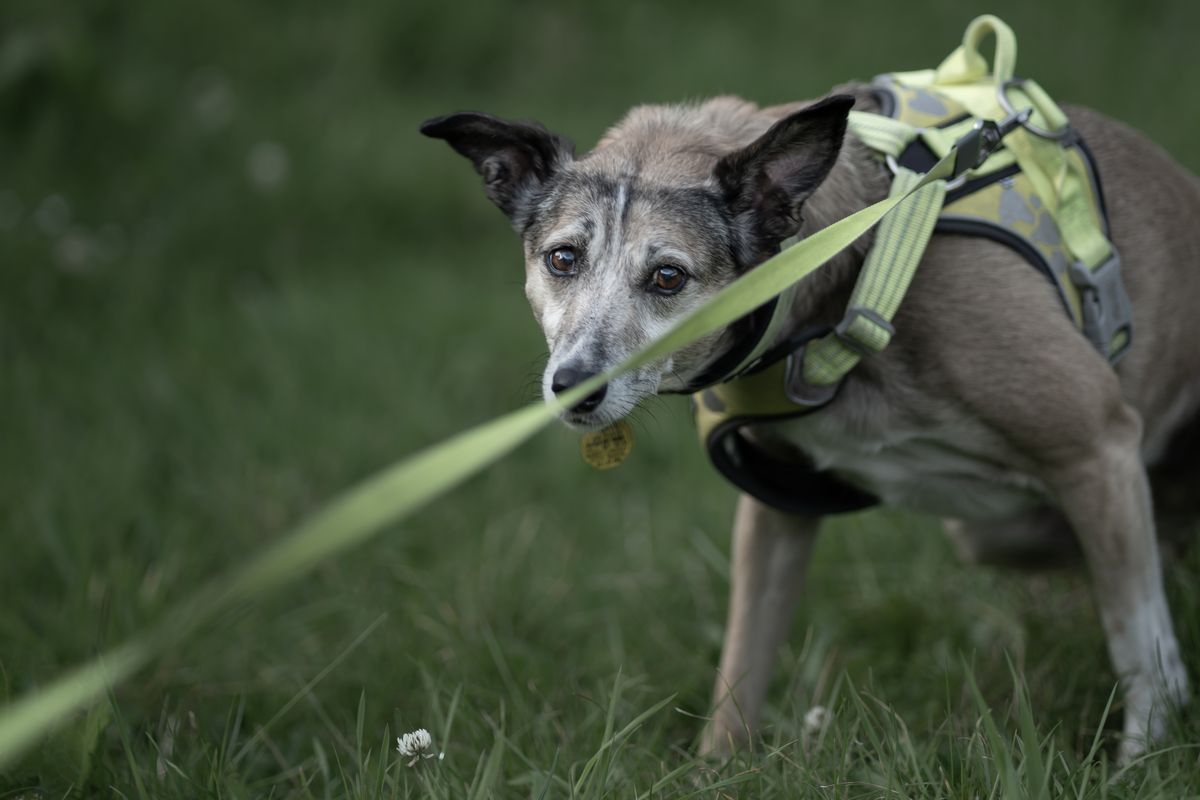
If your dog pulls on the leash, the most likely reason is that the walk has never been clearly defined. A standard walk is a mix of two different jobs, sniffing and travelling, with no signal for where one ends and the other begins, so the dog fills the gap with its own plan at its own speed. Add arousal, because most dogs leave the house too excited to process anything, and you get a dog at the end of the lead with its weight forward for the whole loop of the block.
Pulling is not strength, stubbornness or dominance. And it is rarely fixed by the things most owners try first, which are a new harness or more heel drilling. Both treat the symptom. The dog still has no idea what the walk is.
The walk your dog thinks it's on
Watch an ordinary walk from the dog's side. It is allowed to sniff the first tree, then pulled off a smell without warning, then left to drift to the next pole, then hurried across a road, then scolded for dragging toward the park. There is no pattern in any of that. Nobody has told the dog what this outing is or what its job is, and when the rules are unclear, the dog writes its own. Its rules are simple: move at dog speed, follow the nose, get to the good bits. Pulling is just the dog executing its own plan while attached to a slower animal.
The dog is not being defiant. It is being reasonable inside the only brief it has.
Pulling is arousal before it is anything else
Now look at the dog's body. Up on its toes, body elongated, weight forward, chest into the harness. That is a dog too high on its waterline to process anything you do. At that level of arousal the dog cannot learn, which is why the heel practice that works in the kitchen evaporates on the street.
The leash itself makes this worse. Wanting to reach things and being held back from them, over and over, is frustrating, and that frustration pushes the baseline up across the walk and across the week. A dog that walks at high tide every day starts arriving at the front door already high. That is why the first ten minutes are usually the worst, and why the fix starts before the door opens, not halfway down the street.
Split the walk into its two modes
In my programs the walk stops being one blurry activity and becomes two clear ones. They are two of the four modes, and each has its own start, its own rules, and its own end.
ANCHOR is travelling with a human. The lead is short but loose, and the dog's job is to process the street and choose to stay with you. It is brain work, not a military heel. I am not commanding the dog through it. I set the walk up so that staying with me is the obvious choice, and the dog makes it. A dog that has chosen to walk with you a hundred times walks with you. A dog that has been commanded to heel a hundred times is still waiting for the command.
EXPLORE is being a dog. Nose down, pottering, reading the news on every pole, ideally on a long line. Low arousal is the rule. This is where the sniffing lives, and the dog needs it. Skipping it does not make a better walker, it makes a frustrated dog.
The mode is announced, it holds while it holds, and it ends cleanly before the other one starts. Within a couple of weeks the dog knows exactly which walk it is on, and the pulling loses its reason to exist. For young dogs and reactive dogs I go a step further and replace walks entirely with cycles at the start, because a dog that cannot regulate yet cannot handle even a well-structured street.
Stop negotiating through the lead
The handler's half of the problem is the conversation most people hold through the leash. Small ineffective tugs, a "no" every few metres, pleading energy, then an apologetic pat. The dog understands none of it. One clean action beats ten half-actions, and a lead held tight for the whole walk teaches the dog that pressure is the normal state of walking, at which point pressure stops meaning anything at all. The lead hangs loose as the default. That is the whole vocabulary.
What about no-pull harnesses?
There is no best tool, only the right tool for this particular dog and this particular handler. How the dog pulls decides the equipment: a dog that drives forward off its back legs is a different fit from a dog that rears up into the harness. And a tool the handler cannot manage, physically or mentally, is useless however well it suits the dog. This is why I fit equipment in person rather than publishing a list, though my recommended gear page covers the principles. The honest summary: the right tool can make pulling harder to do while you train. No tool can explain the walk to the dog. That part is training.
What not to do
Do not lure the dog through the walk with a treat at its nose, because a dog following food is not processing the street or choosing anything, and the walking disappears with the treat pouch. Do not swing between yanking the lead and apologising for it, which is noise in both directions. And do not keep changing equipment hunting for the one that fixes it, because the pulling does not live in the hardware.
The order that works
Wait for a beat of real calm before the door opens, so the walk starts as low as it can. Split the walk into ANCHOR and EXPLORE with clean starts and ends, so the dog finally has a brief. Keep the lead loose as the default and make any correction one clean action. Give it a couple of weeks of consistency. The dog learns what the walk is, the baseline comes down, and the pulling stops paying its way.
Common questions
Is my dog pulling because it's dominant?
No. Pulling is a dog moving at its own speed toward things it wants, with no clear brief for what the walk is. The dominance framing gives the behaviour a motive it does not have. Most pulling dogs are excited, not ambitious, and the fix is clarity and a lower baseline, not a power struggle.
Will a no-pull harness fix the pulling?
It can reduce the force while you train, and for some dogs it is the right tool. It does not teach the dog what the walk is, so on its own the fix does not last. There is no best tool, only the right tool for this particular dog and this particular handler, and the way the dog pulls decides which one that is.
Should I let my dog sniff on walks?
Yes. Sniffing is EXPLORE, and a dog needs it. The problem is not the sniffing, it is the blur: sniffing and travelling mixed together with no signal for which is which. Give EXPLORE its own clear start and end, and it stops competing with the walking.
Why is the pulling worst at the start of the walk?
Because the dog leaves the house at the top of its excitement. It has been anticipating the walk since you picked up the lead, so it starts with its arousal already spiking. Wait for a beat of genuine calm before the door opens, and keep the first stretch boring. A dog that starts the walk lower finishes it lower.
My dog walks nicely until another dog appears. Is that still pulling?
No, that is arousal spiking at a trigger, which is a different problem with a different fix. Lunging toward another dog is not solved on the walk itself. It is solved by bringing the dog's baseline down at home so the trigger has less to land on. If that sounds like your dog, start with the reactive dog series rather than leash equipment.