
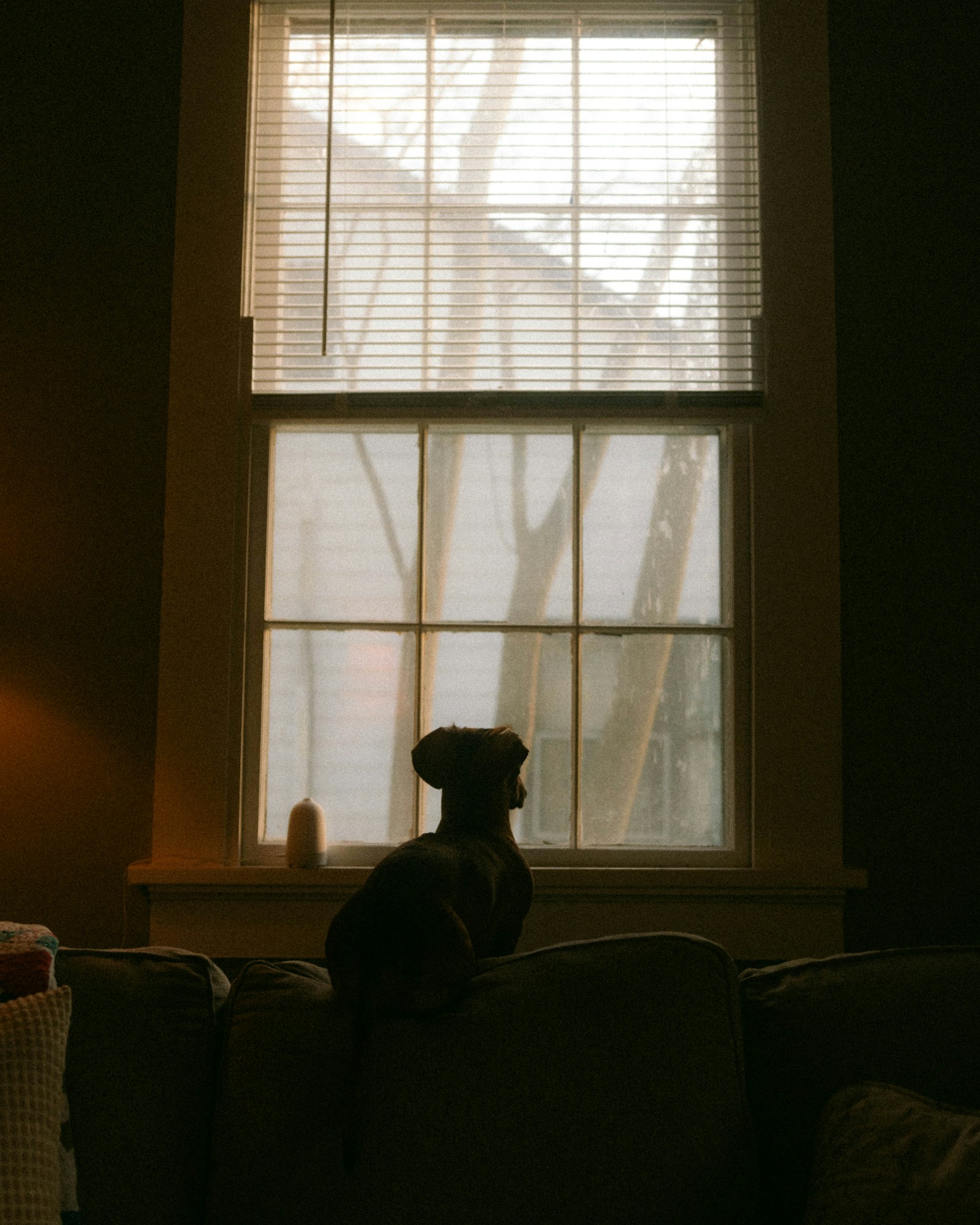
If your dog barks at the window all day, the fastest fix is to take away the window: block the view, move the dog's resting spot off the front of the house, and stop the barking from rehearsing itself, because every bark at a passing person or dog raises your dog's baseline arousal and makes the next bark easier.
That is the short version. Most owners try to solve window barking by telling the dog off, and it never holds, because the telling off is happening after the bark, in the middle of a wave the dog is already riding. The dog has spotted a courier, a dog on the footpath, a leaf doing something suspicious, and by the time you have crossed the room, the reaction is already underway. You are arriving late to a moment that is, to the dog, the best part of its day.
Because that is the part owners miss. Window barking feels like a problem to you and a job to the dog. The dog sees a trigger, barks, and the trigger goes away. The courier walks on, the dog on the footpath disappears around the corner. To your dog, the barking worked. It chased the thing off. It does not matter that the courier was always going to leave. The dog learns that patrolling the glass and barking at what passes is a successful, satisfying use of an afternoon, and a dog with a successful job will keep showing up for work.
What the window does to the waterline
Every dog has a baseline level of arousal, a waterline, and triggers push it up. A dog that spends the day at the front window is a dog being topped up all day long. Person, dog, car, bin truck, possum, each one is a small wave, and the dog never gets all the way back down to flat before the next one arrives. By the evening you have a dog that is wired, snappy, hard to settle, and reacting to things it would have ignored in the morning. The window did that. Not one big event, just a hundred small ones with no recovery in between.
This is why window barking is rarely only about the window. It quietly raises the dog's whole day. A dog that lives at high tide on the windowsill is more reactive on the walk, more reactive at the door, more reactive to the cat, because its starting point is already high. Lower the input at the window and the rest of the day often comes down with it. You can read more about that pattern in the waterline model at the bottom of this page.
Take away the window first
The first move is the least glamorous one. Stop the dog rehearsing the behaviour. A behaviour that gets practised daily gets stronger daily, so the priority is to make the practice stop while you do the slower work underneath it.
Block the view. Frosted film on the lower half of the window, a closed blind, furniture moved so the dog can't station itself at the glass. If the dog patrols a particular window or a spot at the front door, close that room off or move the dog's bed to the back of the house, away from the street. You are not punishing the dog. You are removing a job it should never have been given.
People worry this is avoidance, that the dog should learn to cope with the window instead. It is the opposite. A dog cannot learn to be calm about a thing while it is busy rehearsing being frantic about it ten times an hour. You take the trigger away so the arousal can actually drop, and a dog at a lower baseline is a dog you can then teach.
What to do instead, mode by mode
Removing the window leaves a gap, because the barking was meeting a need, badly. The dog was getting stimulation, a sense of purpose, something to do. Take that away and give nothing back, and you get a frustrated dog. So you fill the gap properly, using the four modes.
CALM is the one most window-barkers are short on. CALM is rest on your terms, on a tether or in a crate, where the dog learns that demanding behaviour gets nothing and only a settled dog gets released. A dog that has never learned to switch off will default to patrolling, because patrolling feels like doing something. Teaching real CALM gives the dog a better answer to the empty afternoon than the window.
PLAY is the other lever. Most window-barkers are under-engaged with their person and over-engaged with the street. Real one-on-one play, tug or a proper game of chase-and-catch, builds the bond that makes you more interesting than whatever is walking past. A dog genuinely bonded to you through play will choose you over the window. Without that bond, the window wins, because it is the most interesting thing on offer.
EXPLORE has a place too, but a careful one. A dog lying under your chair watching the garden in a low, relaxed state is fine. A dog stationed at the front window scanning the street is not EXPLORE, it is patrol, and the moment it tips into barking the mode was wrong and the dog needs to go back into CALM. The difference is the arousal, not the activity.
And when the dog does bark, give it nothing. No eye contact, no talking, no touch, no treat. To an over-aroused dog every one of those reads as you joining in, even a sharp "no". You answer the barking by being boring about it and by managing the environment so it happens less, not by adding your own noise on top of the dog's.
The order that works
Block the view so the rehearsing stops. Move the dog off the front of the house. Build CALM so the dog has somewhere to be that isn't the window. Build PLAY so you outrank the street. Then, much later and only if you want to, you can reintroduce a managed view with a dog whose baseline is low enough to handle it. Most owners find they never bother, because a quiet house is the thing they actually wanted, and they have it.
Common questions
Why does my dog only bark at the window and not on walks?
Often it is the opposite, the window dog is also harder on walks, just less obviously. The window gives the dog a safe distance and a barrier, so it barks freely and the trigger always leaves, which makes the behaviour very rewarding. On a walk the same dog may freeze or pull instead. Either way the underlying arousal is the same, and lowering the window input usually helps the walks too.
Should I let my dog watch out the window if it stays quiet?
A dog lying calmly and watching the garden in a low, relaxed state is fine. The problem is the dog that stations at the glass and scans the street for things to bark at. That is not relaxing, it is patrolling, and it keeps the dog's arousal topped up all day. If the watching tips into barking or stiffening, block the view and give the dog a proper rest spot instead.
Will blocking the window just move the problem to another window?
Sometimes, if you only block one and leave another open. Block or manage every spot the dog uses to patrol the street, and move its resting place to the back of the house. The point is to stop the behaviour rehearsing anywhere, not to play whack-a-mole with one pane of glass while leaving the next one open.
My dog barks at the window when I'm not home. What do I do?
This is the most important one to manage, because the dog is rehearsing the behaviour unsupervised all day. Close blinds, frost the lower windows, or set the dog up in a room away from the street before you leave. A dog barking at the window for hours alone is arriving at a high waterline by the time you get home, which is why so many of these dogs are wired in the evening.
Is window barking the same as guarding the house?
Not quite. Some of it is barrier frustration, the dog wants to get to the thing and can't. Some is the dog chasing off a perceived intruder and being rewarded when it leaves. Most window barking is a mix, fed by boredom and a high baseline. The fix is the same either way: stop the rehearsal, lower the baseline, and meet the dog's real needs through the four modes rather than letting the street do it.