
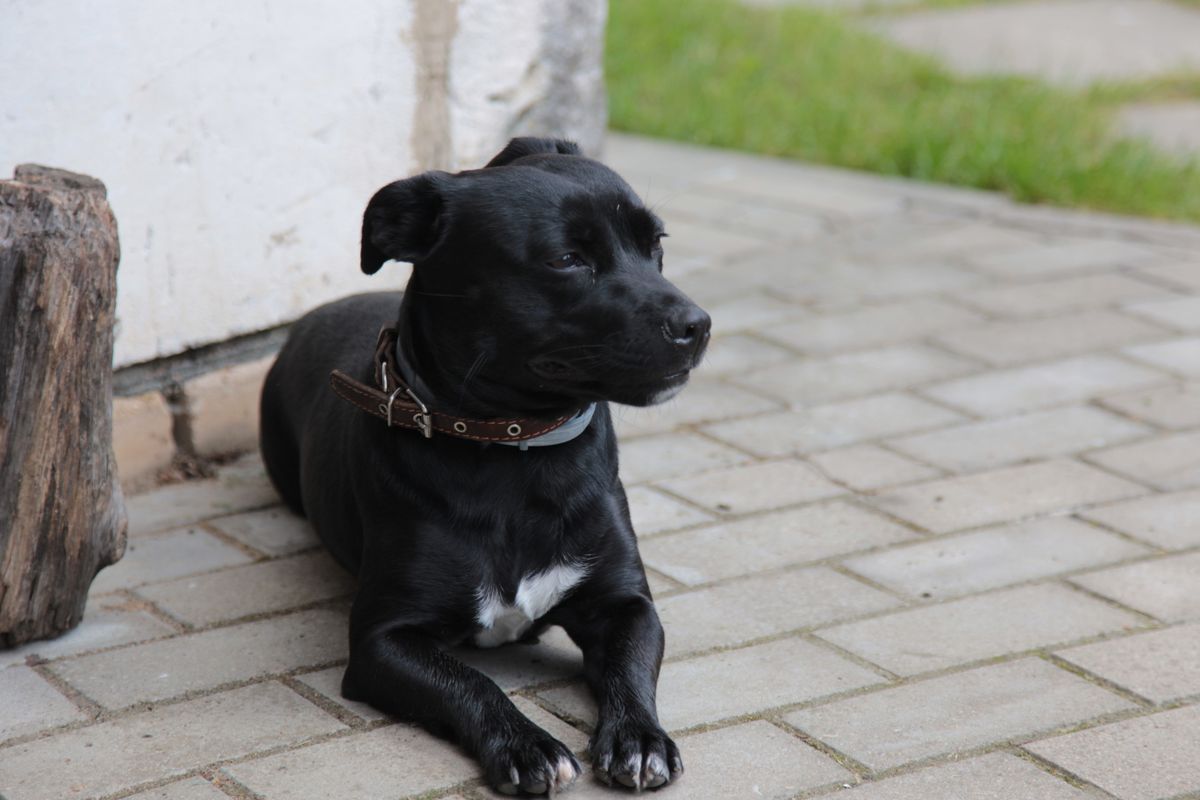
It is one of the first things Staffy owners ask me, usually with a flinch, because they have heard the reputation and they have caught their dog doing something that scared them. The honest answer is that the breed is not the problem people think it is, and also that a Staffy will absolutely get you into trouble if you treat it like a smaller, calmer dog. Both things are true.
What Staffies were actually bred for
The Staffordshire Bull Terrier was bred to be handled, closely, by people, in situations where a dog that turned on its handler was useless. The result is a breed that is, as a rule, deeply people-oriented. The nickname is the nanny dog for a reason, and most Staffies I meet want nothing more than to be in your lap with their whole body. Human aggression is not where their reputation should sit. A well-bred, well-raised Staffy is one of the softer dogs you will meet with people.
Where the bull-breed history does show up is arousal and other dogs. Staffies tend to run hot. They get excited fast, they are powerfully built, and some carry dog-directed reactivity that has nothing to do with how they feel about humans. A Staffy that is brilliant with every person it meets can still be a handful when another dog appears, and that is the part owners need to take seriously rather than the part the headlines worry about.
Why most Staffy trouble looks worse than it is
Two things make a Staffy's behaviour read as aggression when it often is not. The first is the body. A Staffy at the end of the lead, lit up and pulling, is fifteen kilos of muscle with a wide jaw and a loud voice. The same level of over-excitement in a Whippet would barely register. The breed does not get the benefit of the doubt, so ordinary over-arousal gets read as menace.
The second is the off-switch, or the lack of one. Staffies are not great at coming down on their own. They tip into excitement quickly and they sit there, because nobody taught them how to get back out. A dog that cannot self-settle looks like a dog with a problem, when really it is a dog that was never shown the way down. Read the actual signals and most of the time you are looking at the wide Staffy grin, the wiggling back end, the soft eye of a dog that is thrilled rather than threatening. The work is learning to tell that apart from the genuinely hard signals, the stiffening and the making-big I describe in the post on aggression.
What a Staffy actually needs
Three things, in proportion. Real outlets for the drive, because a Staffy with nowhere to spend its energy will find somewhere you do not like. One on one PLAY does more for a Staffy than a long aimless walk, because it burns the arousal and points the dog's intensity at you rather than the environment. A genuine off-switch, taught through CALM, so the dog learns it can come down even when something exciting is happening, the cafe test that so many Staffies fail not from temperament but from never being asked. And the right equipment for a strong dog, fitted to this dog and this owner, because a Staffy you cannot physically manage on a bad day is a Staffy whose training never gets a chance.
Do that, and the reputation mostly evaporates. What you are left with is a sensitive, people-soft, slightly over-the-top dog that needed structure and an outlet, not a muzzle and a warning label.
When to get help
If the dog-directed reactivity is already rehearsed, or your Staffy is strong enough that you are losing the physical battle on walks, that is worth sorting early rather than waiting for it to harden. The private training program starts by reading your dog and getting you the off-switch first. I work across Newport, Williamstown, Docklands and Melbourne's inner west.