Reading body language is the whole job because a dog tells you what it is about to do long before it does it, and every owner I've worked with has come in watching the wrong thing. They're watching for the lunge, the bark, the moment it goes wrong. By that point the dog has been talking for thirty seconds. They've been missing the conversation.
Body language reading is not a supplementary skill. It is the skill. Once you have it, the behaviour problems you've been trying to manage become readable. Once they're readable they become predictable. Once they're predictable, you stop being surprised by your dog and start responding earlier, with less, and getting better results.
The conversation that happens before the bark
Scout was a dachshund cross Jack Russell who would lunge at cars. Sam, one of his owners, described watching a video of an earlier session and seeing it. The lunge had appeared to come from nowhere. But when she watched the video back and paused it, she could see exactly what was there. He had tracked the end of the street before the car appeared. His ears went forward. His body shifted weight to the front. By the time the car turned in, he was already at the threshold. The lunge was the last frame of a five-second sentence she'd been missing every time.
"He immediately looks towards the end of the street after the car has passed, understanding that the cars come from that direction."
That observation came from Sam after several weeks of watching Scout closely. The dog wasn't just reacting to cars. He had learned where they came from. He was watching for them before they arrived. Anticipatory arousal. The body language was broadcasting it clearly. Sam had only started seeing it because she'd been taught what to look for.
What a wagging tail actually tells you
Most owners watch the tail. Wagging tail means happy dog. That's a first-grade read of a more layered signal than the tail alone.
A wagging tail tells you the dog is aroused. It tells you nothing else on its own. The direction, height, speed, and stiffness of the wag tell you what kind of arousal you're looking at. A high, stiff, flagged tail wagging in short arcs is not a happy dog. That's a dog preparing to react. A wide, sweepy low wag with a loose, slightly wiggly body is a relaxed dog. A tucked tail that still wags is a dog who is conflicted: trying to offer appeasement while also being anxious. Same "wagging tail" surface read. Three different things going on underneath.
Rex was a cavoodle who was manageable outside but reactive at home with visitors. His tail height was the readout. "His confidence explodes when he's in the house. You can tell by how high his tail is." That sentence explains more about Rex's behaviour than a month of command training would have. Once his owners could see the tail height as information about his arousal state, they stopped trying to talk him down and started managing his position and structure instead.
The signals worth learning
Eyes
Soft, blinking, relaxed means regulated. Hard and locked on one point means fixated. The "whale eye" (whites visible at the corners, the dog trying not to look directly at the thing while still tracking it) is one of the most reliable pre-bite signals there is. A dog showing whale eye is uncomfortable enough to bite and polite enough to be trying not to. Read it and create distance.
Ears
Forward and tracking means alert, the dog is orienting on something. Pinned flat back against the skull means fear or extreme stress. Neutral and relaxed means settled. The useful signal is the flick: ears that snap to a specific direction before the dog's head has turned are telling you what the dog is monitoring before their attention is visible in any other way.
Mouth
Open with a loose, lolling tongue is a relaxed or warm dog. A mouth that closes suddenly, in a dog who was just panting, is a significant shift. They've registered something. The panting stops because the dog has switched into a higher state of focus. This is one of the fastest early signals and one of the least watched.
Body weight
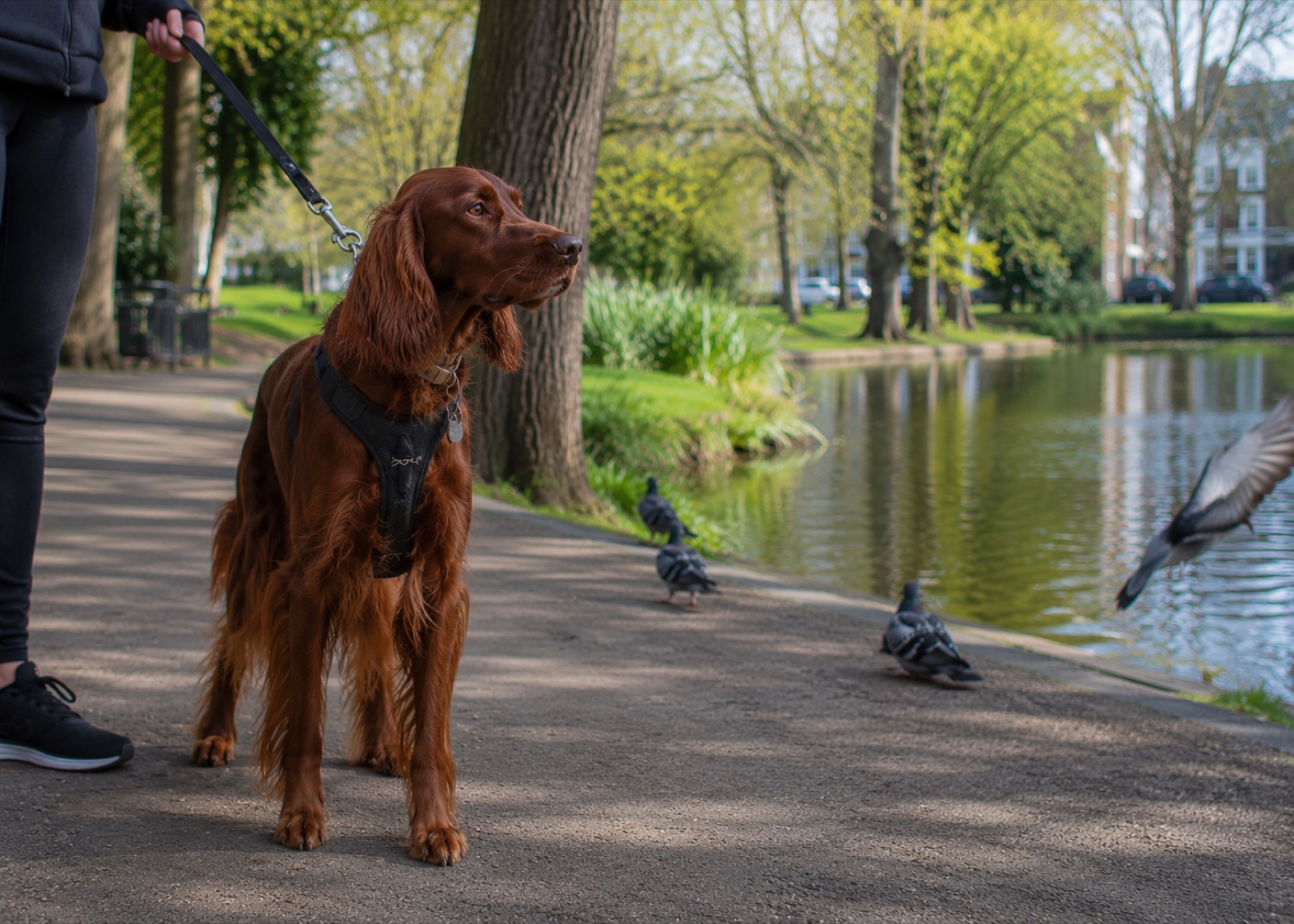
Even weight on four paws means a neutral, settled dog. Weight loaded forward means engagement or pursuit. Weight shifted back means avoidance. A dog bouncing lightly on their front paws while staring at something is loading to launch. Emily noticed it in Scout perfectly: "he's got ears up and body forward but does make a good choice to keep moving." She was reading two signals and a decision at the same time. That's advanced. Most owners only get the ears or the weight shift, not both.
Paw lift
A single paw lifted off the ground, just hovering, is a stress and uncertainty signal, not a trained behaviour. Max was a harrier cross who came to me for reactivity to trucks and large vehicles. In a Coles car park at his first outing to an unfamiliar environment, he spent twenty minutes with his paw lifting repeatedly as he took in the sounds and movements. He wasn't reactive. He was uncertain. That paw lift told me where his arousal was before anything louder happened. Owners who miss it find out at the bark.
Stress licking and rhythmic movement
Erin, who owned Figgy, a Maltese cross Poodle, sent me a video one evening with the message: "There's something about the way that he's licking and moving a bit rhythmically that's making me nervous." She was right to be nervous. Repetitive licking, especially in a slow, deliberate rhythm without a physical reason for it, is a self-soothing signal. The dog is trying to manage its own arousal. Erin hadn't been trained to read body language. She had watched her dog closely enough that the behaviour pattern registered anyway. That's the right instinct: when something feels off, it usually is.
The micro-second tells
These are the bits that get missed most. The head-flick back to a trigger after the dog has looked away. Checking. The lip lift the dog tries to suppress. The tongue flick at the exact moment a stranger reaches out. The freeze that lasts a quarter of a second before the bark. The freeze in particular is the last signal before eruption and the one owners almost never catch in real time. Watch video in slow motion and you'll find it every time.
Trying to read your own dog and not sure what you are seeing? Five quick questions will tell you where to start.
Take the 2-minute assessment →What de-escalation looks like
Reading escalation is one direction. Reading de-escalation is the one that changes how the training goes, because it tells you when the dog is ready to re-engage, when to say "ready" and resume PLAY, when to call it a good session and move on.
Sam listed what she was trying to catch after Scout had been triggered by a car, and she had it almost exactly right: ears low or relaxed, looking away from the trigger, eyes gone soft again, body weight no longer forward, tail curved rather than stiff and straight. Any combination of those signals is de-escalation. You don't need to wait for the full set. One clear signal is enough to call "ready" and see if the dog snaps back into play mood.
Missing de-escalation is expensive because the window closes fast. A dog who has come down from a trigger and is being held in structure will start to climb again if you wait too long. The moment the body language shifts, you move.
Why Sam missed the pre-lunge signal
After a session where Scout lunged unexpectedly, Sam came back with a question: "Did you see what I missed in terms of his body language? He seemed so low in his volcano but I missed the body cues right before the lunge, I think."
That question is exactly the right one to be asking, and the fact that she asked it meant she was already reading at a level most owners never reach. The pre-lunge signals are subtle precisely because the dog has been working hard to contain the arousal. A dog who is actively trying to stay regulated will show smaller signals: a slight forward lean rather than a full weight shift, a mouth that closes for two seconds rather than locking shut, ears that track for a moment rather than locking on.
Learning to see those compressed signals takes repetition, and most of it happens through video review. Not in real time. Real time is too fast and there's too much else to manage. You watch the video back later, with the audio off, pausing every two or three seconds. The body language you missed in the moment is obvious on a still frame.
Nervous and reactive look different
This distinction matters more than most owners realise. A dog can be worried without being explosive. The signals are different, and the intervention is different.
Max was not an explosive dog. He didn't lunge at trucks. He braced, tracked them, tensed. His threshold was high enough that he stayed under it most of the time. Except in new environments with strong sound echoes, where everything compressed and he'd bark before anyone saw it coming. When I watched him at Bunnings, I could see his uncertainty in every paw lift, every head swivel, every pause before committing to a direction. I told his owners: "He's nervous about the echo in the environment. Let him watch for a bit. When the coast is clear, say 'ready' to PLAY."
The point was to let the dog read the environment at his own pace rather than pushing through it. Movement worried him when he was uncertain; stillness let him process. Owners who drag a nervous dog past the thing that's worrying them get one of two outcomes: the dog shuts down, or they get the bark they were trying to avoid.
Herne was a Munsterlander who showed the opposite problem: inconsistency. His owners described it: "Some cycles he nails his ANCHOR, ignores people, stays relatively calm. Then the next cycle he's set off by any person, dog, shadow, or reflection of himself." What looks like inconsistency to an owner is usually variability in baseline. The dog is fine when their arousal is managed and their rest is solid. The same environment becomes unbearable when it isn't. Body language reading gives you the live readout of which state the dog is in before you've committed to the walk.
How I teach this in sessions
Body language reading is the first skill inside the Still Waters methodology. Before PACE, before cycles, before any structural changes to the day. If you can't read what the dog is showing you, you can't time anything else correctly.
In a private session, the first thing I do is watch. Owner and dog, whatever they normally do. I'm not quiet because I'm unfriendly. I'm quiet because I'm reading. I'm watching what the dog is showing me about the household, the routine, the relationship, and what the owner is responding to or missing entirely.
After twenty or thirty minutes I'll usually point out four or five things the dog has done that the owner hasn't registered. The moment an owner sees what they've been missing, the session changes. They stop listening for commands to land and start watching for signals. That shift alone cuts reactive incidents within a week, before we've changed anything else.
The bark is the last thing in the sentence. By the time you hear it, you've missed all the punctuation that came before.
The fastest way to start learning
Sit somewhere your dog isn't actively working with you. Don't talk, don't interact, just watch. Do this for ten minutes. Notice every shift. The ear flick. The eyes tracking movement in the next room. The yawn that comes when arousal is climbing rather than when the dog is tired. The tongue flick. The breathing change. The way the head moved when someone walked past the window.
Most owners who do this realise they've never actually watched their dog. They've watched what their dog was doing, which is a different thing. The doing is the output. What you're learning to read is the state underneath it.
If you want to learn this with feedback on your specific dog, the private training work is built around exactly this. The first session is mostly me showing you what's already there. By the time clients leave the program, they're reading their dog as fluently as they read their kid's mood. Not a useful analogy: it's literally the same skill.