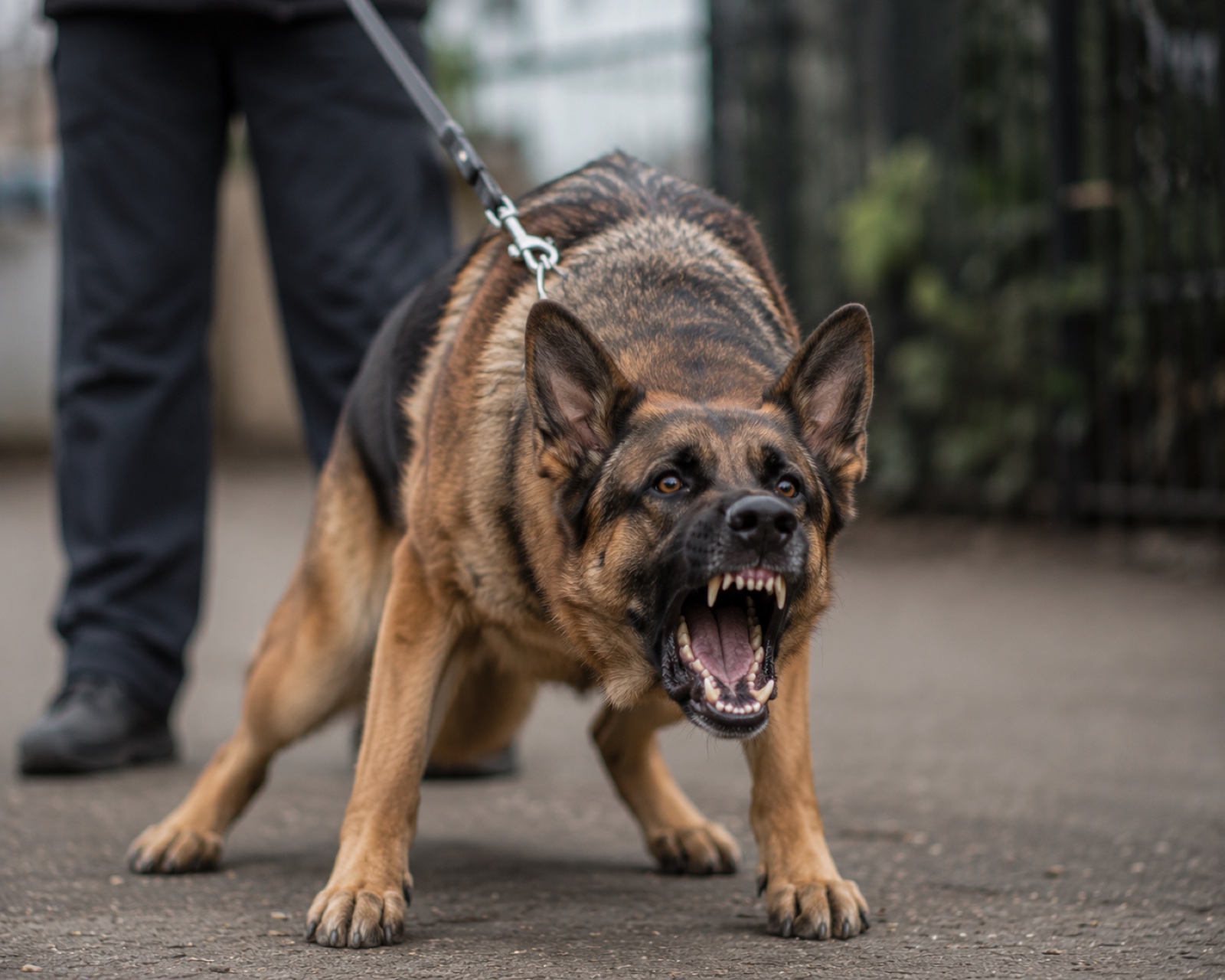
Training an aggressive dog starts with teaching the owners to read the warning signals the dog is already giving, while a muzzle keeps everyone safe so the work can happen at all.
When Tim and Lucy came to me with Ella, a German Shepherd from Newport, the dog had already been through multiple elbow surgeries, was on anti-anxiety medication, and had a habit of lunging without the kind of build-up most reactive dogs give you. Tim described her as a "silent assassin." She wouldn't stare or posture or escalate in the way that lets you prepare. She would just go. That combination of pain history, high baseline anxiety, and compressed warning signals put her in a category that requires patience and a long view.
Teaching owners to read a dog who gives very little
The first thing I do with any reactive dog is get footage. Lots of it. I can describe what I'm looking for, but until I can see the handler's footwork, their lead tension, the dog's ear position in the seconds before a reaction, I'm guessing at what's actually happening.
Ella's early footage changed my view of how "silent" she actually was. Tim and Lucy had said she gave almost no warning. Frame by frame, she gave plenty. She was just giving it at a speed they hadn't been trained to read yet. At three minutes and eleven seconds in one clip, she gulped. At three fifteen, her head started rising. At three twenty-three, she looked away from the trigger and immediately looked back at it, harder. At three twenty-five, the chest came up. At three thirty, she lunged.
That sequence took nineteen seconds. That is not a dog who gives no warning. That is a dog whose owners had not yet learned the language she was speaking. My job was to teach them that language.
"Let's practice reading 'dog.' A new language I am going to teach you."
We worked through dozens of clips like that one, and Tim and Lucy got fast. Within a few sessions they were catching the gulp, the head rise, the double-take back to the trigger. That eighteen-second window became a two-second lead: enough to shift position, steady the lead, change direction before the lunge. Not always. Enough of the time to change the pattern.
The muzzle and what it is actually for
Tim and Lucy had been to multiple trainers before seeing me. Two of those trainers were bitten by Ella in sessions. That is not a criticism of them. It is a statement about what happens when a dog with this kind of presentation is worked without a muzzle in place. If the dog can bite and the bite produces any reaction (a step back, a flinch, the session ending), the behaviour is reinforced. A muzzle removes that variable entirely.
In the first session, Ella was muzzled. During that session, she attempted to bite me. Because she was muzzled, I did not move back. I did not flinch. I did not give her any information that the attempt had produced a result. That is the lesson a dog like Ella needs to learn first: biting does not get what you want. With the muzzle on, she could learn it, and so could I.
After that initial consultation, my instruction for every outing was to muzzle up. Not because of what it does to the dog. Because of what it does to the handler. There is always going to be some level of fear when you are walking a dog who has previously bitten. That fear is not irrational and I am not trying to talk anyone out of it. But fear occupies mental space. The more of your attention is going toward managing your own anxiety about what might happen, the less capacity you have left to actually read the dog, respond to her signals, and follow through on what needs to happen in the moment. Tim and Lucy relaxed when the muzzle was on. A relaxed handler is a far better handler.
What the four sessions changed
By the end of the program, Ella was comfortable with visitors coming into the house. She could walk past people and dogs on the street without it becoming an incident. The compressed, almost-silent warning pattern was still part of how she was wired, but Tim and Lucy could see it now and they had a response for it.
The bigger shift was in the handlers. Tim and Lucy were calmer around her. Not because they had stopped paying attention, but because they had built something to pay attention with. They knew what the signals looked like and they knew what to do with them. A handler who is bracing for a bite transmits that tension through the lead. A handler who trusts their own reading of the dog does not. By the end of the four sessions, Tim and Lucy were the second kind.
Bringing home a second baby
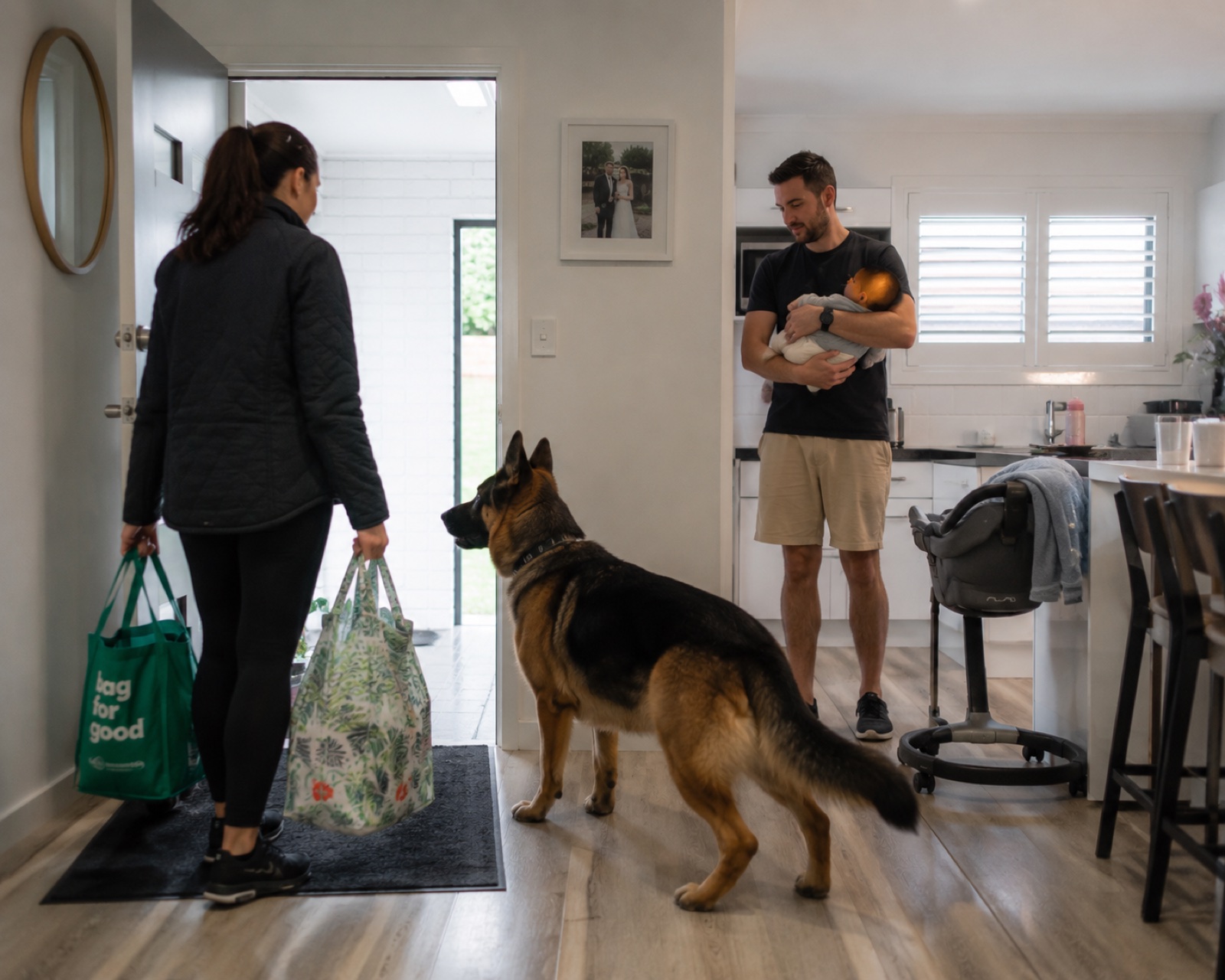
A year after the program ended, Tim and Lucy got in touch. Ella had been going well. They were about to welcome a second child and they mentioned how stressful it had been last time: how much of their attention had gone into managing Ella through the adjustment, how much they had been carrying. They wanted advice on how to handle the homecoming.
My advice was simple. Come home like you came home with the shopping. No introduction. No show-and-tell. No gathering around the baby for Ella to investigate. Walk in, put the bags down, continue as normal. The less the humans make of it, the less Ella has to process about it.
Lucy did exactly that. Ella wagged her tail, gave the baby's feet a sniff, and walked off to her spot. No incident. No escalation. Tim sent me a message the same evening. "Kept it low key. Ella just wagged her tail and gave feet licks. We didn't make a big deal and she didn't make a big deal."
They had also been able to reduce Ella's medication significantly over the previous months. The baseline had dropped enough that she was managing a level of household stimulation that would previously have kept her sitting close to the top of her waterline most of the day.
The fact that they came back to me a year later, calm enough to ask for advice rather than in crisis, is itself the outcome of the program. Four sessions built the framework. What Tim and Lucy brought to it over the year that followed is what got them here.
If your dog has a bite history and you have been through trainers who couldn't hold a session safely, or who told you the dog wasn't workable: the program starts with understanding what is driving the behaviour. Private training begins there.