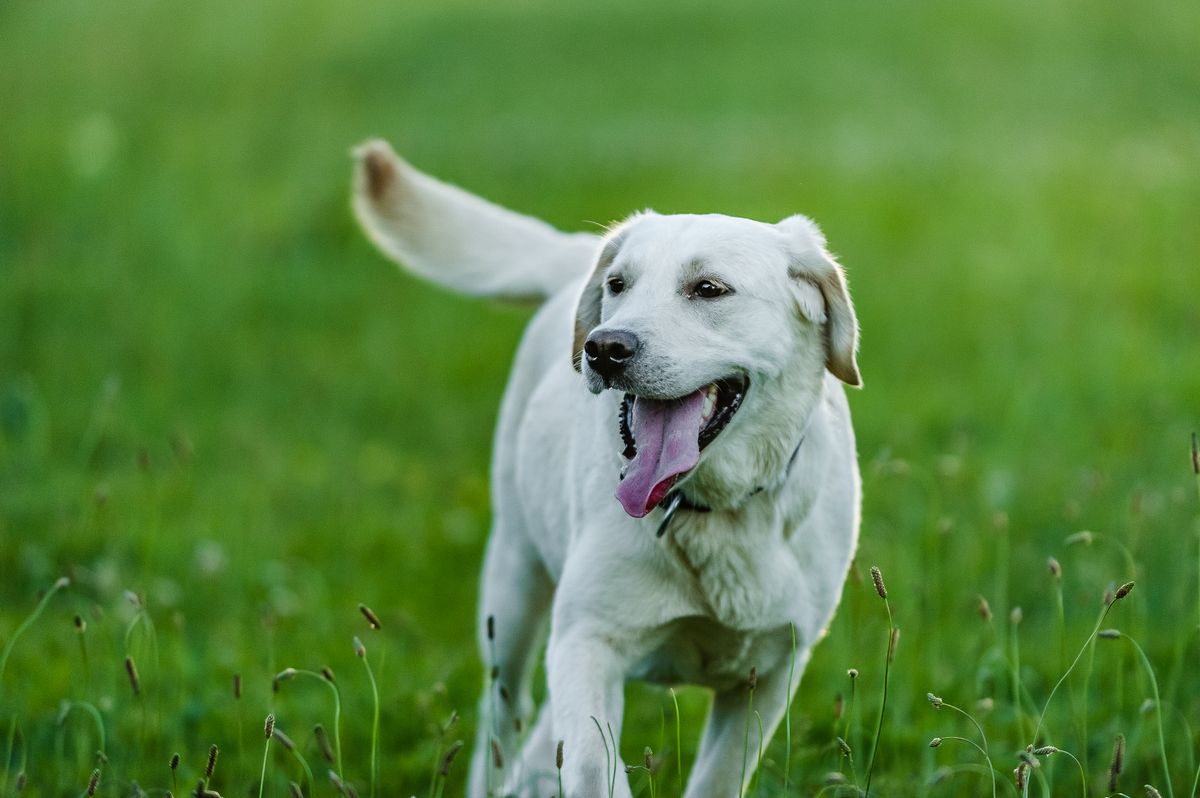
Training a Labrador means managing a high-drive gun dog through a long adolescence, and building a bond that food alone cannot. Labradors are the most popular dog in the country for good reason. They are friendly, biddable, brilliant with kids, and they want to be part of everything. They are also, for the first couple of years, a large, strong, food-obsessed teenager with a mouth, and that is the part owners are usually less prepared for. Most of the Labradors I see are not difficult dogs. They are good dogs whose energy and adolescence got ahead of their training.
A gun dog that grows up slowly
The Labrador was bred to work a full day in the field, retrieving, swimming, using its nose, taking direction from a handler. That is a lot of engine. Drop that engine into a suburban backyard with a walk around the block and the energy does not disappear, it comes out as counter-surfing, digging, jumping, and grabbing things to start a game of chase.
On top of the drive, Labradors mature slowly. The body is adult well before the brain is, and you can easily be living with a forty-kilo dog that still thinks like a six-month-old puppy. That gap is where most owners start to struggle, usually somewhere between eight months and two years, exactly when people expect the dog to have settled down. It has not. It is just bigger.
Why food is a gift and a trap
A Labrador will do almost anything for food, and that makes early training feel easy. It is also the thing that quietly undermines a lot of Labs. A dog worked entirely on food is a dog whose attention you are renting, and a Labrador is very happy to take the wage and ignore you the moment something more interesting than your treat pouch appears. I see Labs that are perfect in the kitchen with a handful of kibble and completely checked out at the park, and the owners cannot understand why.
The food drive is genuinely useful, but it cannot be the whole relationship. What holds a Lab's attention in a distracting place is the bond, not the bribe, and the bond gets built through real one on one PLAY, not just feeding. A Labrador that has learned you are more fun than the environment will choose you. A Labrador that has only ever been paid will choose the higher bidder.
The mouth, the jumping, and the off-switch
Two of the most common Labrador complaints, mouthing and jumping up, are the same problem: a friendly, over-aroused dog using its body to start social contact. Asking for a sit does not fix it, because the excitement is still there underneath and the dog jumps again the moment you look away. What changes it is answering the feeling rather than the action, giving the dog none of the four things it is after, no eye contact, no talk, no touch, no treat, until it settles, and letting the calm version earn the greeting.
The bigger piece is the off-switch. Labs are enthusiastic about everything and not naturally good at coming down on their own, so CALM has to be taught: time on a tether or in a crate where the dog learns that demanding gets nothing and only a settled dog gets out. A Labrador that can switch off is a Labrador you can take anywhere. One that cannot is exhausting in a way that no amount of walking fixes, because a tired Labrador is often just a fitter Labrador.
What a Labrador actually needs
Engagement that uses the head and the nose, not just the legs. Brain work in ANCHOR and real retrieve-style play does more for a Lab than a longer walk. A genuine off-switch through CALM. The relationship built first so the food becomes a bonus rather than the only lever. And patience with the timeline, because a Labrador rewarded for the right things and given an outlet does grow into one of the easiest dogs you will ever own, usually right about the time you had given up expecting it.
If your Lab is in the thick of adolescence and getting away from you, the private training program is built for exactly this. I work across Newport, Williamstown, Docklands and Melbourne's inner west, and online between sessions.